Japan in Transition: Kimono and Everyday Life in Meiji-Japan (1868โ€“1912)

In February, I had the incredible opportunity to curate “Japan in Transition: Everyday Life and Clothing in Historical Photographs”. The exhibition explored the Meiji era (1868โ€“1912). This was a period when Japan was rapidly modernising, yet continuing to hold onto its deep-rooted traditions. I selected twenty historical photographs from German museum archives. These images reveal the tension between old and new in a way that still feels relevant today.

In this post, Iโ€™d love to introduce you to five key images from the exhibition. Each tells its own story of change, resilience, and the beauty of everyday life in Meiji-era Japan.


City Scapes of Meiji Japan

This lively street scene captures a typical shopping district likely in Edo (modern-day Tokyo). The scene takes place on a warm summer day. This image is fascinating because it shows the cultural shift of the era, highlighting the details of everyday life.
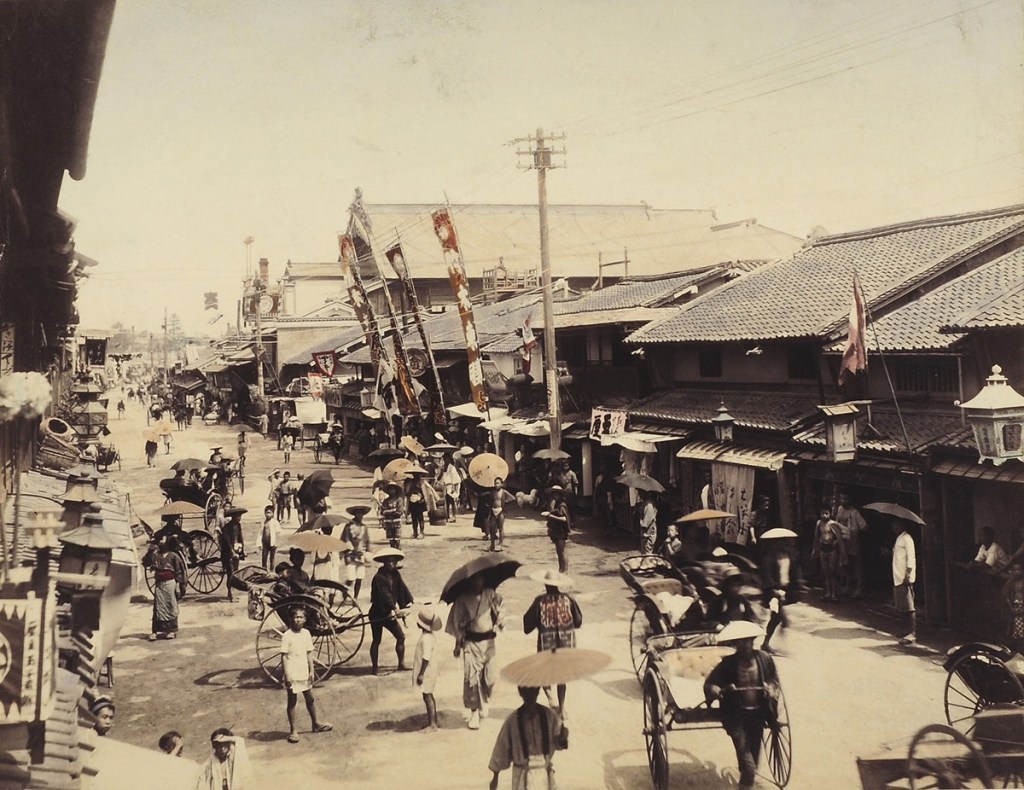
StraรŸenszene, 1880โ€“1890. ยฉ Public Domain, Museum fรผr Kunst & Gewerbe Hamburg.

Look closely at the umbrellas: The round, paper-covered wagasa (ๅ’Œๅ‚˜, traditional Japanese parasols) stand alongside dark, European-style umbrellas. They offer a clear sign of Western influence seeping into daily routines. The headwear tells a smilar story: we see Japanese kasa (็ฌ , straw hats) but also Western-style rounded hats.

In just one frame, this photograph reveals the Meiji eraโ€™s duality. The picture shows a society embracing modernity while, at the same time, it holds onto its traditions; one sunshade, one hat at a time.


Staged Traditions: The Art of Crafting ‘Exotic Japan’

This portrait by the Italian photographer Adolfo Farsari captures a young woman in a patterned kimono. She is delicately holding a temari toy (ๆ‰‹ๆฏฌ), a traditional Japanese handball originally crafted from scrap fabric.
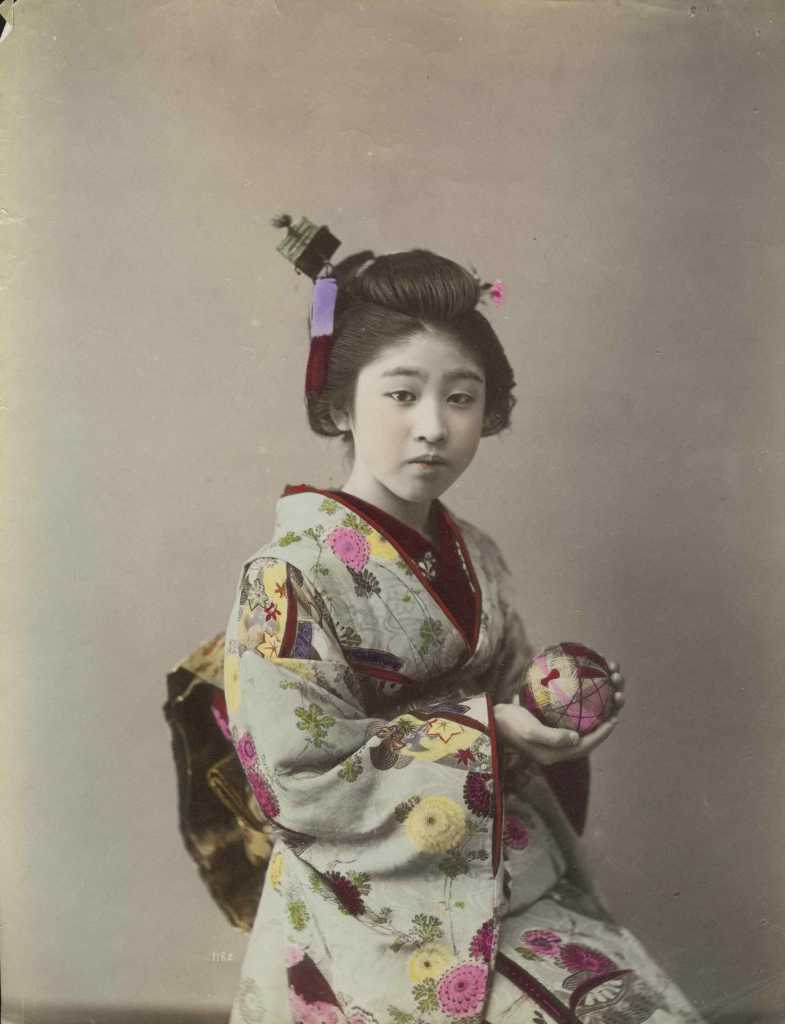
Sitzendes Mรคdchen mit einem Temari-Ball in der Hand, ca. 1890. ยฉ CC BY-NC-SA 4.0, Staatliche Museen zu Berlin, Ethnologisches Museum.

Farsariโ€™s work gained renown for its blend of Western portrait aesthetics with Japanese motifs. This blend shaped an image of “exotic Japan” that fascinated European audiences. In this artwork, the temari ball, initially a humble childrenโ€™s toy, becomes a symbol of craftsmanship and elegance. It represents the artful staging that defined much of Meiji-era photography.

Farsariโ€™s approach mirrors that of other photographers of the time, like Kusakabe Kimbei, who similarly staged scenes to cater to Western tastes. Their studio portraits often featured stereotypical figures like ‘the geisha’ in an elaborate kimono.

These portraits preserved a romanticised vision of Japan even as country rapidly modernised. It was a play between documentation and clichรฉ, between reality and the myth of “exotic Japan.”


Working Worlds: The Real Everyday

T. Enami “Fan Factory” offers a glimpse into the authentic working life of Meiji-era Japan. Unlike his earlier, more staged compositions, this photograph captures a family-run workshop.
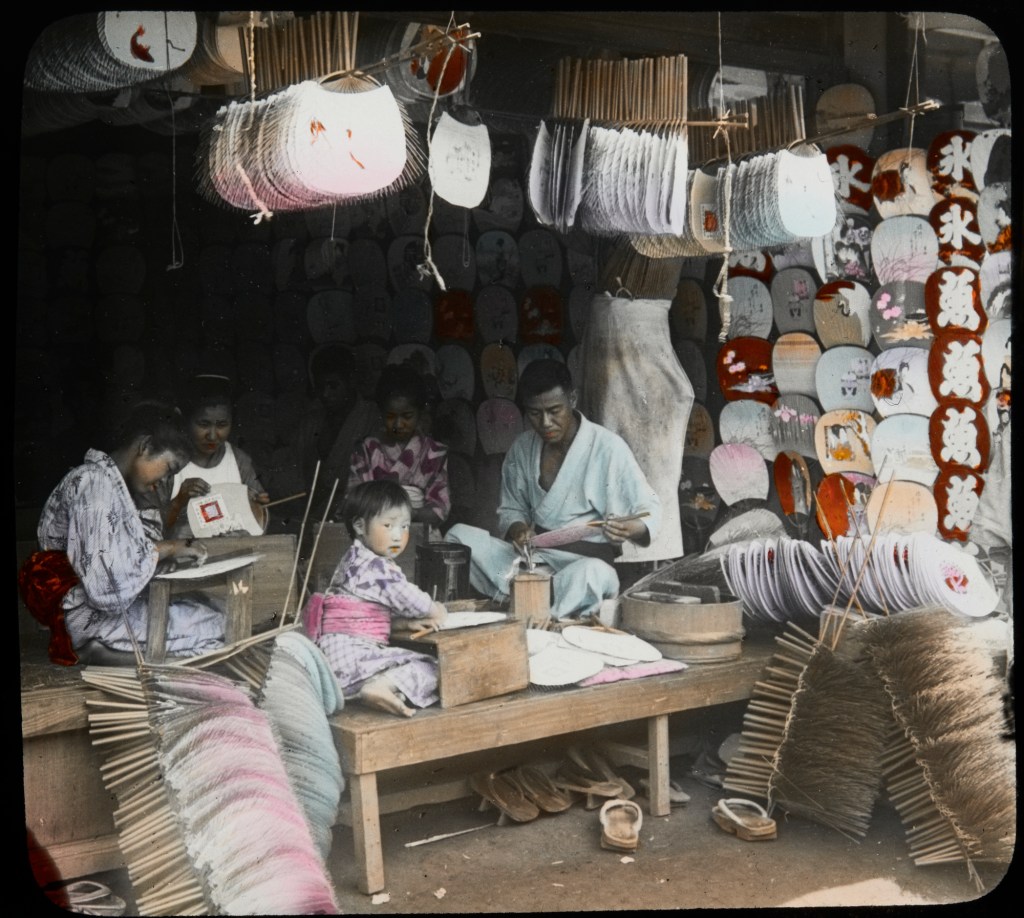
T. Enami, Fan Factory, um 1900. ยฉ CC BY-SA 4.0, Mรผnchner Stadtmuseum, Sammlung Fotografie.

The father, mother (both dressed in white), and three children collaborate in crafting uchiwa fans (ๅ›ฃๆ‰‡). These flat, rigid hand fans were practical everyday items, as well as also popular souvenirs and advertising tools. They were often adorned with landscapes, celebrities, or lucky symbols.

What makes this image so compelling is its unfiltered realism, highlighting the familyโ€™s collective labor. This effort was a hallmark of small businesses during the Meiji period, with every member contributing to the craft.

Many households blended established conventions with the practical demands of survival while Japan underwent sweeping social changes. These included school reforms that began to reshape education and labour dynamics. Children were increasingly encouraged to attend school. However, many families, particularly in rural areas or small workshops, still depended on their helping hands to sustain the household.


Moments of Leisure and Joy in a Changing World

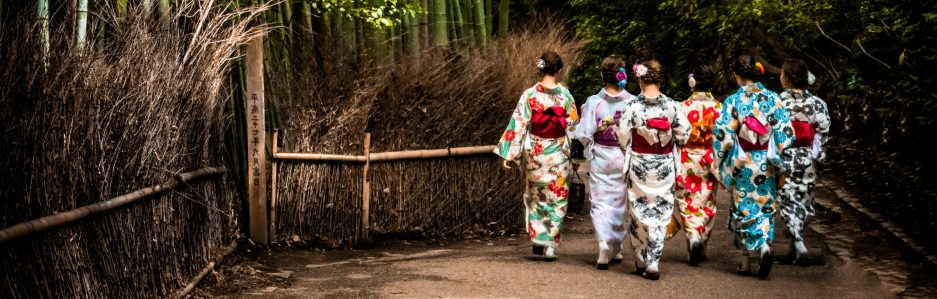
This photograph of the banks of the Hozugawa River in Arashiyama, Kyoto, transports us to a place of timeless tranquility. It was a retreat that drew people from all walks of life during the 19th century.
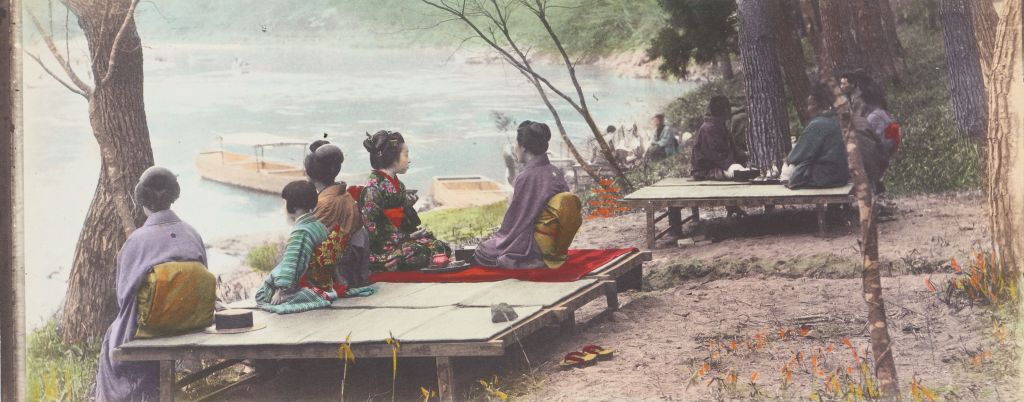
An den Ufern des Flusses Hozugawa in Arashiyama, Kyoto, 1860 – 1880. ยฉ Public Domain, Museum Natur und Mensch Freiburg.

The image captures the serene atmosphere of the riverbanks. Gentle hills and clear waters provide respite from the hustle of daily life. Arashiyama was more than just a scenic spot. It was a social gathering place, particularly in spring and autumn. Here, the beauty of nature seamlessly blended with Kyotoโ€™s slower way of life.

While cities like Tokyo were rapidly modernising, places like Arashiyama remained sanctuaries of community and continuity. These areas allowed people to escape the pressures of change, providing an opportunity to reconnect with the rhythms of nature.


This final image is my favourite photograph from my research. I see it as a symbol of the curiosity and positivity with which people in Japan embraced photography as part of their daily lives.
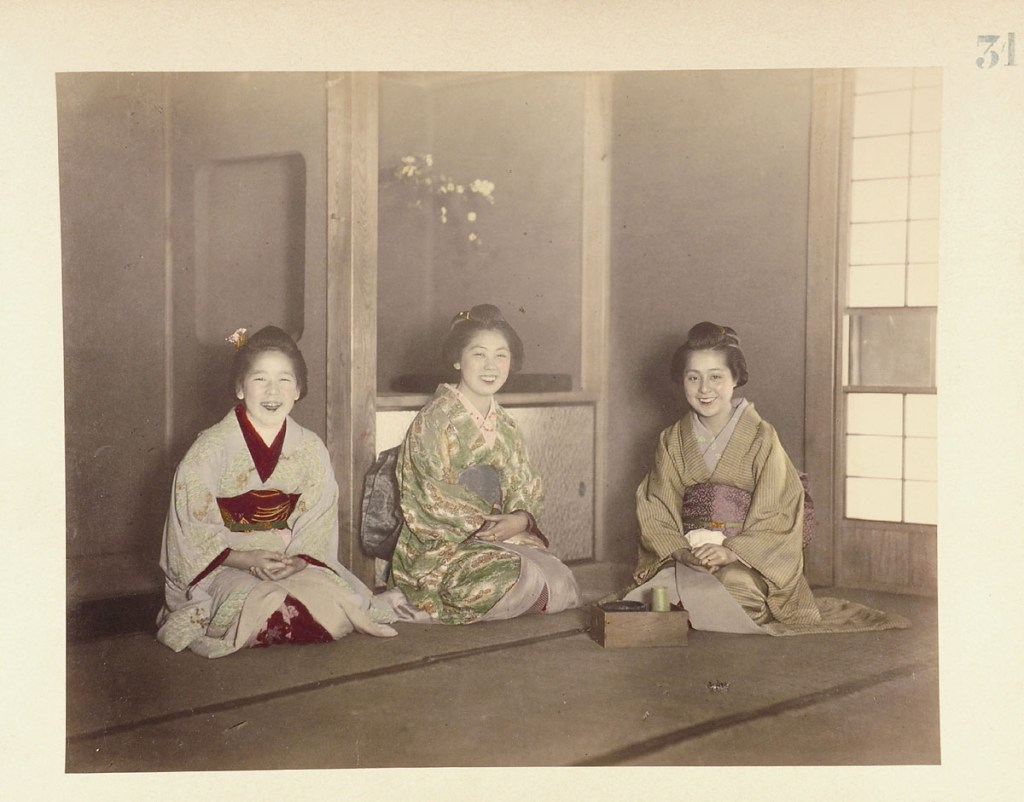
Drei japanische Frauen im Innenraum hockend, 1893. ยฉ Public Domain, Museum fรผr Kunst und Gewerbe Hamburg.

The three young women radiate an uninhibited cheerfulness. This is a reminder that even in an era of rapid change, moments of lightness and connection defined human interaction.

Thereโ€™s also an intriguing detail that sets this image apart. All three women are wearing rings on their left hand. Rings were not historically part of Japanese dress. These subtle accessories hints at the growing influence of Western fashion and the blending of cultures during the Meiji era. This is a small sign of Japan redefining its identity, with people absorbing new trends while staying rooted in conventions.

In this single frame, we see the essence of the Meiji period. It was a society in transition, where old and new coexisted. Even the simplest moments carried the weight of history. Itโ€™s a beautiful note to end on, capturing the spirit of resilience, adaptability, and joy that defined the era.


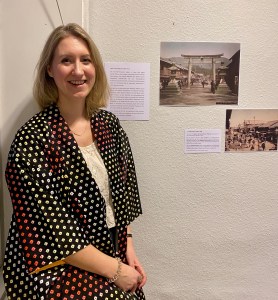
“Japan in Transition: Everyday Life and Clothing in Historical Photographs” (original title: “Japan im Wandel: Alltag und Kleidung auf historischen Fotografien”) was exhibited at the Japan Pop-Up at Ars Japonica in Hamburg. The exhibition curated by Dr. Carolin Becke explored the cultural shifts of the Meiji era through historical photographs from six German museum collections.

Le Chat (Mistral AI), as well as the WordPress AI Assistant, powered by OpenAIโ€™s GPT technology, assisted in writing this blog post.
The Original Merch Drop: Kabuki x Kimono in Edo Japan

Long before fashion week collaborations and limited-edition celebrity merchandise, Japanโ€™s Edo period (1615โ€“1868) was already fusing fame and fabric in brilliant ways. Kabuki actors, the superstars of their time, captivated audiences not only with their performances but also with their bold stage costumes, sparking real-world fashion trends among a growing urban population.

One striking example can be found in a woodblock print held at the Victoria and Albert Museum titled New Designs at Yamatoya [Yamatoya shiire shingata]. Created between 1832 and 1840 by artists Utagawa Kunisada, the image showcases six bold kimono patterns inspired by the kabuki star Bandล Mitsugorล V.

Utagawa Kunisada, New Designs at Yamatoya [Yamatoya shiire shingata], woodblock print, published 1832โ€“40, Victoria and Albert Museum, London.

The print is more than a stylish illustration; itโ€™s a piece of early commercial theatre. In Edo Japan, kabuki actors were the celebrities of their time, and their on-stage looks sparked real-world fashion trends. Kimono shops quickly caught on, producing summer robes and accessories featuring motifs and crests associated with these actors. The actors gained publicity; the shops sold more kimono. Everyone won, especially the fans, who could now wear their admiration quite literally on their sleeves.

In this print, six distinct patterns are displayed like a designerโ€™s lookbook: bold geometrics, stylised florals, crest-like emblems, and flowing linework, each one likely tied to the on-stage persona or costume of Mitsugorล. They reflect not only the aesthetics of the kabuki stage but also the everyday aspirations of Edoโ€™s urban population, who were hungry for novelty, status, and connection through fashion.

Pattern Spotlight: The Kamawanu Crest

One of the most iconic actor-associated patterns of the Edo period is the kamawanu (้ŽŒใ‚ใฌ) motif. The motif is a combination of a sickle (kama, ้ŽŒ), the phonetic character wa (ใ‚), and the ideogram for โ€œnotโ€ (nu, ใฌ). Together, they form a visual pun meaning โ€œI donโ€™t careโ€ or โ€œNo problem.โ€ Though that might sound flippant, it was exactly the kind of cheeky, cool-headed phrase that resonated with kabuki audiences.

Example of the Kamawanu Motif, Composed of Sickle, Ring, and the Kana โ€˜Nuโ€™.

This pattern was famously used by the seventh-generation kabuki actor Ichikawa Danjลซrล and became a massive trend among his fans. It expressed the bold, carefree spirit of the kyลkaku (ไพ ๅฎข), an outlaw heroes who walked the line between criminal and romantic rebel. Wearing the pattern was a way for townspeople to channel that rebellious charisma in their daily life.

A stunning example can be seen in a print of Ichikawa Kodanji IV held by the Ota Memorial Museum of Art in Tokyo. His costume features the kamawanu motif prominently, and the museum notes that this hanjimono (visual riddle) expressed the daring spirit of kabuki and Edo-period masculinity.

Ichikawa Kodanji IV in Kamawanu-Patterned Costume. Woodblock print. Edo period, Ota Memorial Museum of Art, Tokyo.
Unlike formal family crests, kamawanu was theatre-born branding; a witty, wearable declaration of cool. Much like a modern slogan tee, it carried both meaning and affiliation, all in a stylized three-part image. Seen in prints and on actual garments, the pattern tells us just how sophisticated and layered Edo-period โ€œmerchโ€ could be.

What may look like elegant patterning or theatrical flair was, in fact, an early form of visual branding layered with puns, affiliations, and coded messages. The kamawanu crest and actor-inspired kimono patterns remind us that the lines between stage and street, art and commerce, have long been blurred. Edo-period fans werenโ€™t just watching kabuki; they were participating in it. In this light, the floating world wasnโ€™t so far from our own: stylish, expressive, and deeply shaped by the culture of celebrity.

Sewing Kimono โ€“ A Personal Experiment in Fabric, Form, and Patience

Iโ€™ve decided to try something Iโ€™ve never done before: sewing my own kimono. As someone deeply interested in the history and cultural meaning of kimono, this is more than just a sewing projec; itโ€™s a way to explore the garment from the inside out, one stitch at a time.

Iโ€™ll be documenting the process here as I go: from choosing the fabric to figuring out the pattern, cutting, sewing, and (hopefully!) wearing the final result. Along the way, Iโ€™ll reflect on what Iโ€™m learning; not just technically, but also in terms of material culture and my own relationship with the kimono.

Thankfully, Iโ€™m not doing this entirely alone. Iโ€™m getting some wonderful guidance from my friend Maria, the creative mind behind Yohgara Kimono, whose insights and experience have already been incredibly helpful.

This post will be updated regularly, so feel free to check back or follow along as the project unfolds ๐Ÿ™‚

Sewing Kimono (Part 1): The Fabric

Maria and I went to Mahler.Stoffe in Hamburg just to check out the shop with no specific plans. I think I had been there once before, back when I studied fashion design at ESMOD Berlin in 2008. Theyโ€™ve always had a solid selection and reasonable prices, and this visit was no exception.

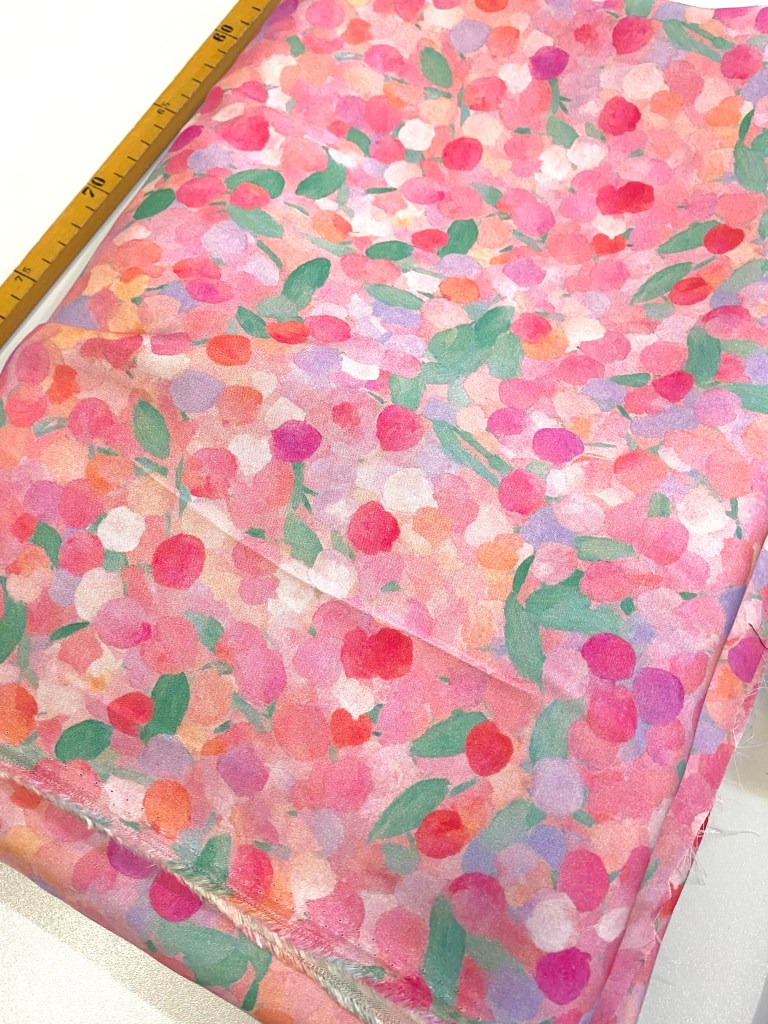
I wasnโ€™t looking for fabric for a kimono that day. But then I saw it: a lightweight cotton that immediately caught my eye. Something about the colour, the way it draped, the subtle texture – it was love at first sight! I didnโ€™t hesitate, and with the help of Maria’s calculations, I bought 4 meters of the 1.45m wide fabric.

And just like that, my kimono sewing journey began.

Furisode Kimono Explained: A Visual Guide to Japanโ€™s Coming-of-Age Attire

When thinking of the Coming-of-Age Day in Japan, one image often comes to mind: young women dressed in striking, long-sleeved kimono known as furisode. Worn to mark the transition into adulthood, these colourful garments are rich in tradition and also full of personal and cultural meaning.

But not all furisode look the same. At the 2024 Yokimono Japanese Market in London, we presented two very different styles: one based on historical dress from the Edo period, and one showing how the furisode is worn today. This article takes a closer look at both styles, explores the symbolism behind their patterns, and considers how the furisode continues to evolve while preserving its role in Japanese rites of passage.


This article is 1,000 words long.
๐Ÿ•’ Estimated reading time: 5 minutes.

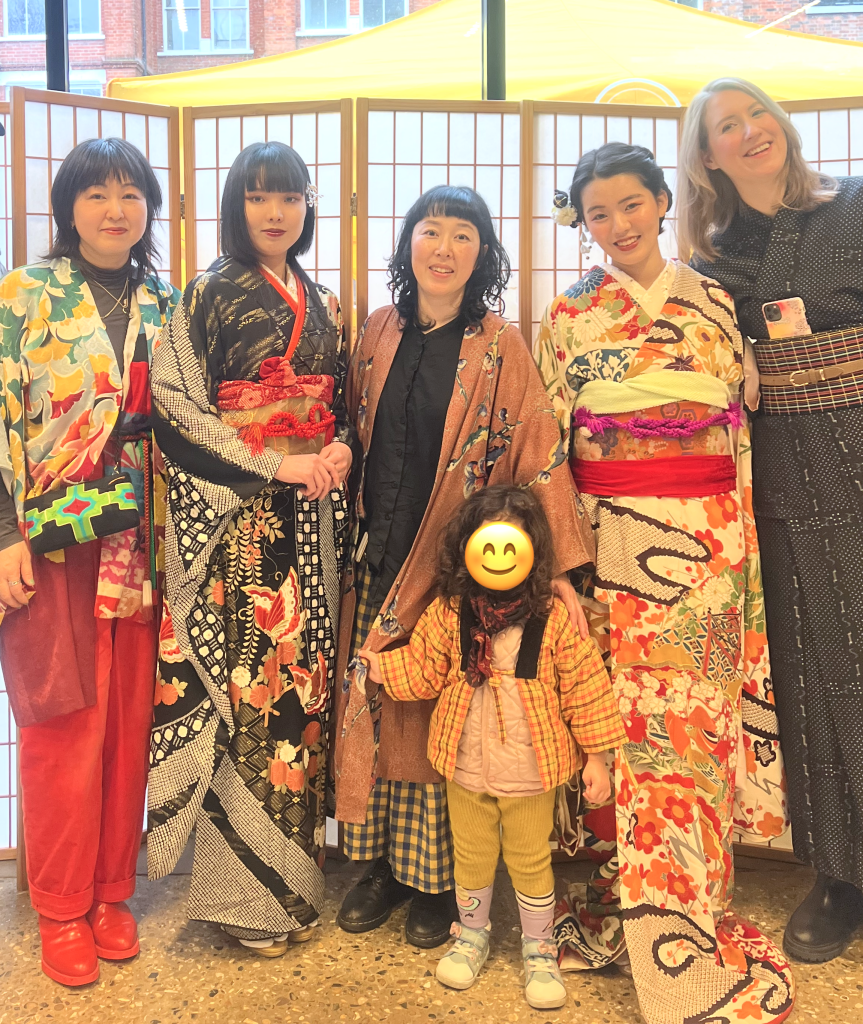
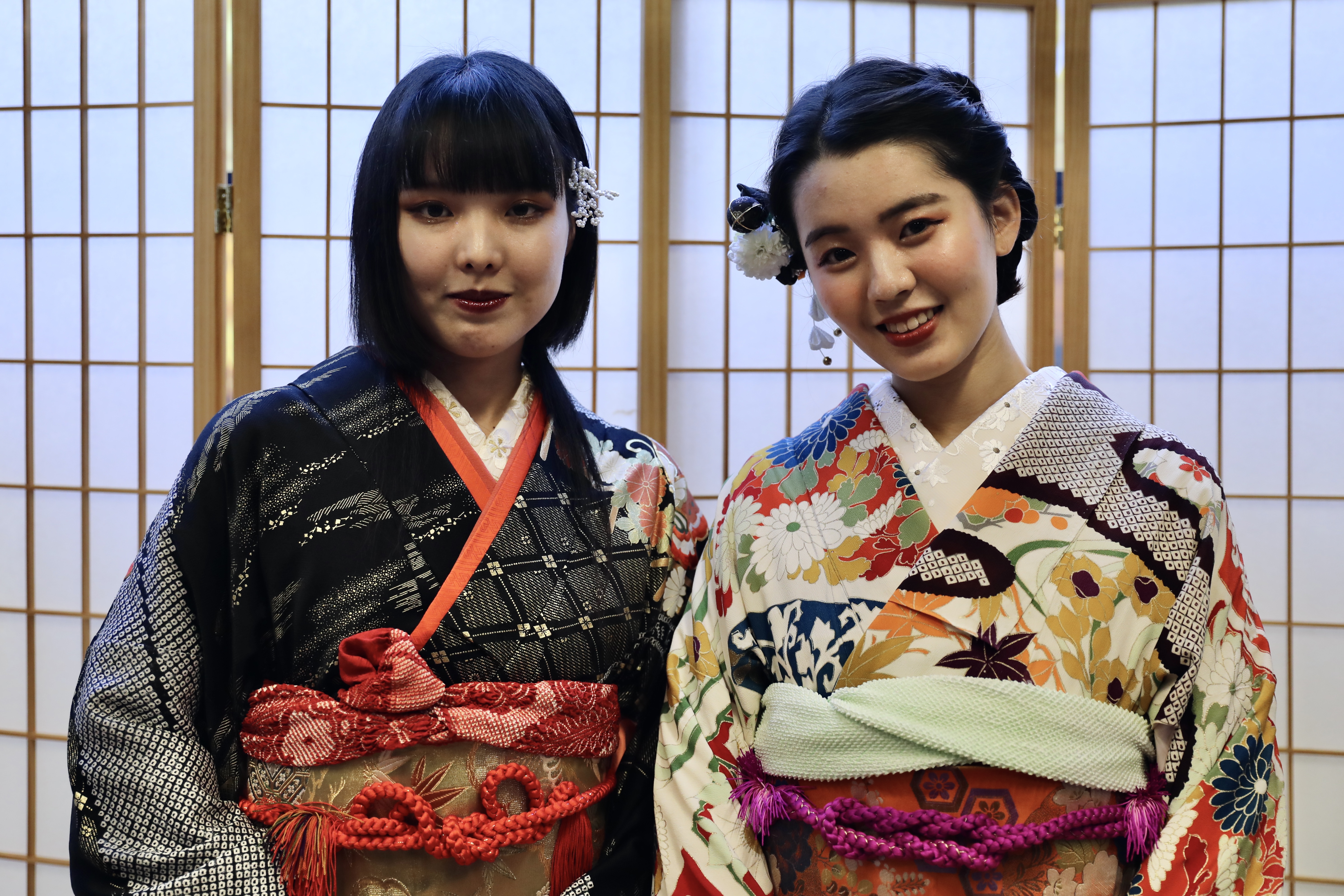
From left to right: Sonoe Sugawara (Furuki Yokimono Vintage), model Chizu, stylist Yuko Sasaki, model Yui, presenter Carolin. All images in this post taken by ใพใชใ•ใ‚“.

What is a Furisode?

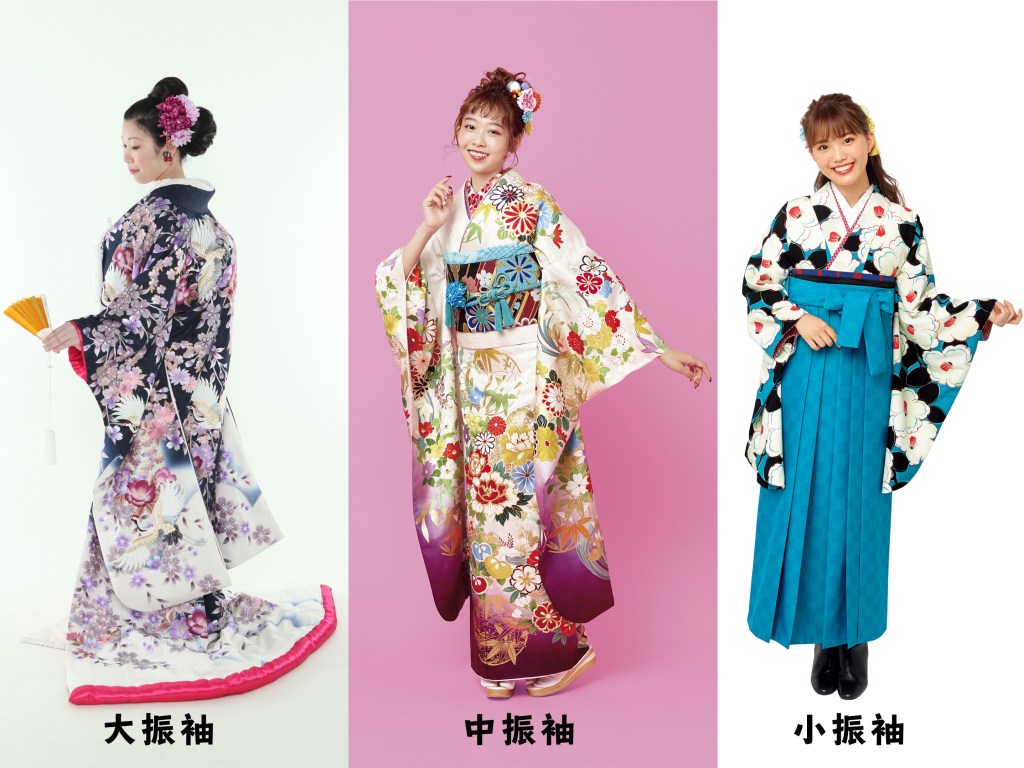
The furisode (ๆŒฏ่ข–) is a type of formal kimono distinguished by its long, flowing sleeves ranging from 85 to 114 cm in length. The name literally translates to โ€œswinging sleeves,โ€ which sway elegantly with the wearerโ€™s movements.

Historically, furisode were worn by young, unmarried women, signaling both youth and availability for marriage. The long sleeves were believed to make a woman appear more graceful and attractive.

After marriage, it was customary to “shorten the sleeves” either by literally cutting them or having the garment altered by a tailor to convert the furisode into a tomesode (็•™่ข–), a formal kimono for married women, which has shorter, more restrained sleeves. This physical alteration marked a symbolic transition from maidenhood to matrimony.

Sleeve lengths vary by occasion: longest for bridal wear (left), medium for Coming-of-Age Day (center), and shorter for graduation (right). Image source: http://aikah.com.

Today, they are most commonly associated with the Coming-of-Age Day (ๆˆไบบใฎๆ—ฅ / Seijin no Hi), a national holiday in Japan that celebrates young people turning 18 years old, which is, since 2022, the official age of adulthood. These garments are often elaborately decorated with seasonal or auspicious motifs, each carrying symbolic meaning.

Furisode Styles Now and Then

For the demonstration at the Yokimono Japanese Market, we showcased two contrasting styles of furisode:

  • A historical Edo-period style, emphasizing traditional elegance and formal symbolism
  • A contemporary adaptation, showing how the furisode is worn today with practical adjustments and personal flair

The Historical Style: Formal Elegance

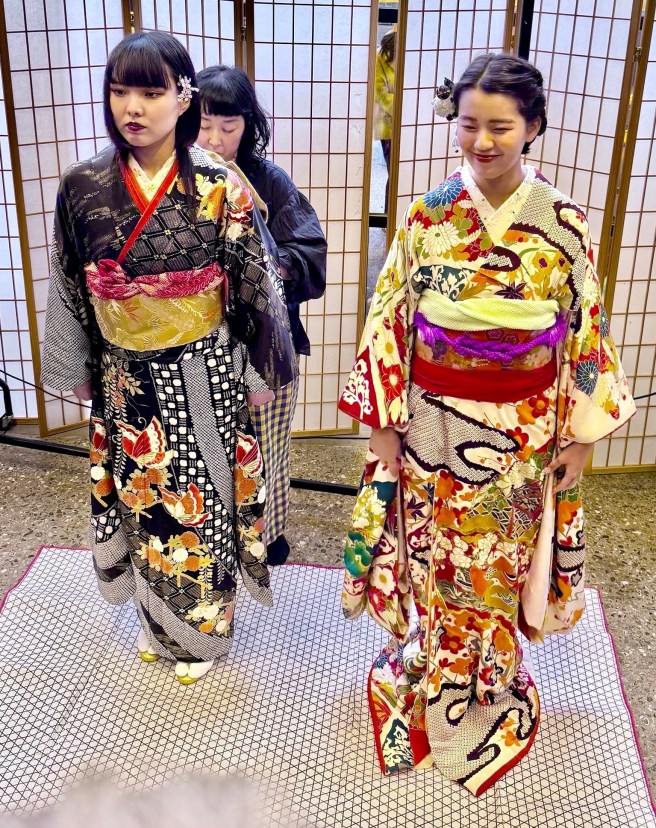
Yui wore a furisode styled in the fashion of the Edo period (1603โ€“1868), a time when clothing adhered to strict codes that reflected social status, age, and marital status. The kimono she wore was richly decorated with a variety of auspicious motifs, each symbolising positive qualities or well-wishes for the wearer:

  • Chrysanthemum (่Š, kiku) โ€“ A symbol of longevity and a floral emblem associated with the Imperial family
  • The โ€œThree Friends of Winterโ€ (ๆพ็ซนๆข…, shลchikubai) โ€“ Plum, bamboo, and pine; a classic trio in East Asian art representing resilience, integrity, and perseverance during hardship
  • Crane (้ถด, tsuru) โ€“ A revered creature in Japanese folklore, symbolizing good fortune, fidelity, and long life

The hem of this kimono was left to trail on the floor, a style considered highly formal and luxurious. In the Edo period, this trailing hem was typical for young women of higher social rank attending important occasions. Today, such styling is rarely seen outside of stage performances or ceremonial roles, such as those of geiko and maiko, where traditional dress is preserved as part of cultural heritage.

The Contemporary Style: Practical and Personal

In contrast to the traditional Edo-period ensemble, Chizu wore a more contemporary interpretation of the furisode, illustrating how modern wearers adapt this formal garment to suit current lifestyles and practical needs. While the furisode remains a symbol of youth and celebration, today’s wearers often choose more accessible ways of styling it.

One key adaptation was the use of the o-hashori technique, where excess fabric at the hem is folded and tucked to create a clean, ankle-length silhouette. This method makes the kimono easier to walk in and helps prevent the fabric from dragging on the ground; an important consideration for modern-day mobility and comfort.

A particularly meaningful element of this outfit was the furisode itself. This kimono originally belonged to Sonoe Sugawara, owner of Furuki Yokimono Vintage and host of the Yokimono Market, who wore it at her own Coming-of-Age ceremony in 1995. It had been gifted to her by her grandmother and has been carefully preserved ever since.

Wearing this heirloom piece today highlights how kimono are not only fashion garments but also carriers of family history, memory, and generational continuity.

The Art of the Obi

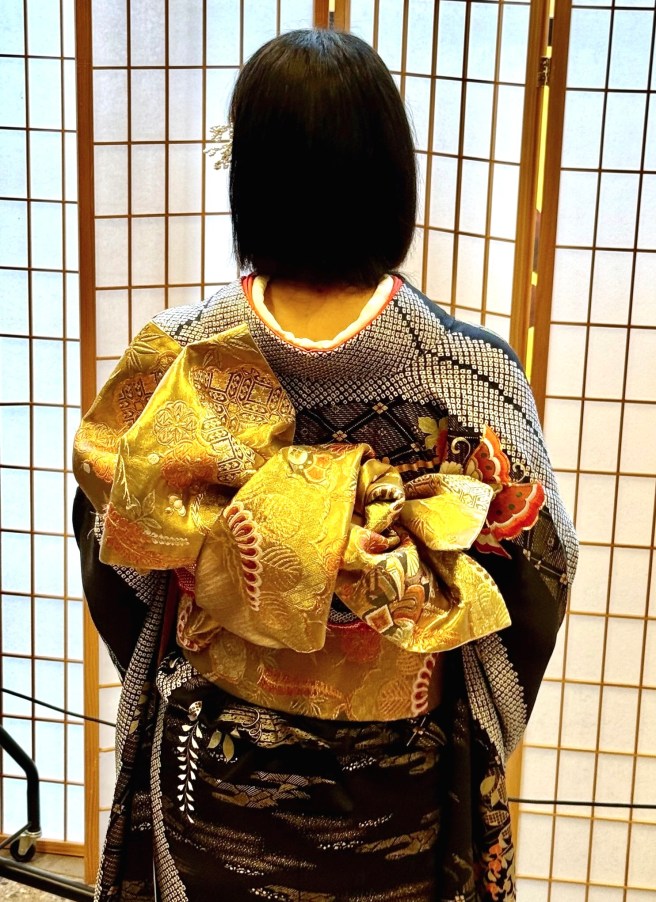
No kimono is complete without the obi, a wide sash tied in the back. Tying the obi is both a technical skill and an art form, often requiring assistance due to the weight, length, and complexity of the knot.

The obi is often the most expensive part of a kimono outfit, as it must be stiff enough to hold elaborate shapes and usually features intricate weaving or embroidery. During the demonstration, Yuko showcased two different obi knots:

  • A formal structured knot worn by Yui matching the grandeur of her historical furisode
  • A rose-shaped obi knot worn by Chizu symbolic of blossoming youth and individuality

Secured with hidden cords and accessories, these knots balance visual beauty with structural durability meant to stay in place all day.

Watch the Presentation

๐ŸŽฅ See both styles brought to life in our full video recording below:

Our live demonstration at Yokimono Japanese Market highlighted not only the stunning beauty of furisode, but also the interplay of tradition and transformation that makes kimono culture so rich and enduring.

Whether worn in classical elegance or reimagined through a modern lens, the furisode remains a powerful expression of coming of age, identity, and celebration in Japan.

Sonoe Sugawara, owner of Furuki Yokimono Vintage
Yuko Sasaki, kimono dresser & stylist
Carolin Becke, kimono expert
Yui, model of the historical style
ๅƒ็  / Chizu, model of the contemporary style

How the Hakama Became a Symbol of Women’s Education in Japan

When attending a university graduation ceremony in Japan, youโ€™ll likely see young women dressed in a traditional garment called the hakama; a wide, pleated lower garment worn over a kimono. While today itโ€™s closely associated with academic achievement and coming of age, the hakama was originally a piece of clothing worn only by men. So how did it become a symbol of female empowerment and education? In this article, we explore the fascinating journey of the hakama, from its roots in samurai culture to its enduring role in Japanese school traditions and graduation ceremonies.

This article is 1,850 words long.
๐Ÿ•’ Estimated reading time: 8 minutes.

Young women during their university graduation. Source: James Pere on Unsplash.

Education Reform and the Rise of the Japanese Schoolgirl

During the Meiji era (1868โ€“1912), Japan underwent a period of intense modernisation and nation-building. Determined to compete with the Western powers and shed its feudal image, the country launched sweeping reforms across all areas of society, from government and industry to infrastructure and education. Central to this transformation was the creation of a strong, literate, and disciplined population capable of supporting a modern state. Education, therefore, became one of the most important tools for shaping Japanโ€™s future.

While education had long been available to boys of samurai and merchant families, the Meiji government now sought to create a national, standardized school system modeled in part on European systems. The 1872 Education System Order (gakusei, ๅญฆๅˆถ) laid the foundation for universal education, and by the 1880s and 90s, the number of schools, and students, was growing rapidly.

Initially, girlsโ€™ education lagged behind. Early on, many believed that education for women should be limited to moral instruction and domestic skills to prepare them for their roles as โ€˜good wives, wise mothersโ€™ (ryลsai kenbo, ่‰ฏๅฆป่ณขๆฏ). However, as the state increasingly realised the broader importance of women in shaping the home and, by extension, the nation, more formal academic opportunities opened up for girls.

But alongside these ideological changes came a very practical issue: what should female students wear to school? The traditional kimono, while elegant, was considered by some as unsuited to the demands of the classroom. Long sleeves got in the way of writing or handling materials, and the layered fabric restricted movement, especially during increasingly popular activities like group gymnastics or walking commutes to school.

Educators and reformers began looking for a uniform that offered both mobility and modesty. The goal was to find clothing that allowed young women to participate fully in a modern education without appearing inappropriate or overly โ€˜Westernisedโ€™. This opened the door for the hakama, a garment that would soon become the visual hallmark of the educated, forward-looking Japanese schoolgirl.

From Samurai Uniform to Student Dress: How the Hakama Was Reimagined

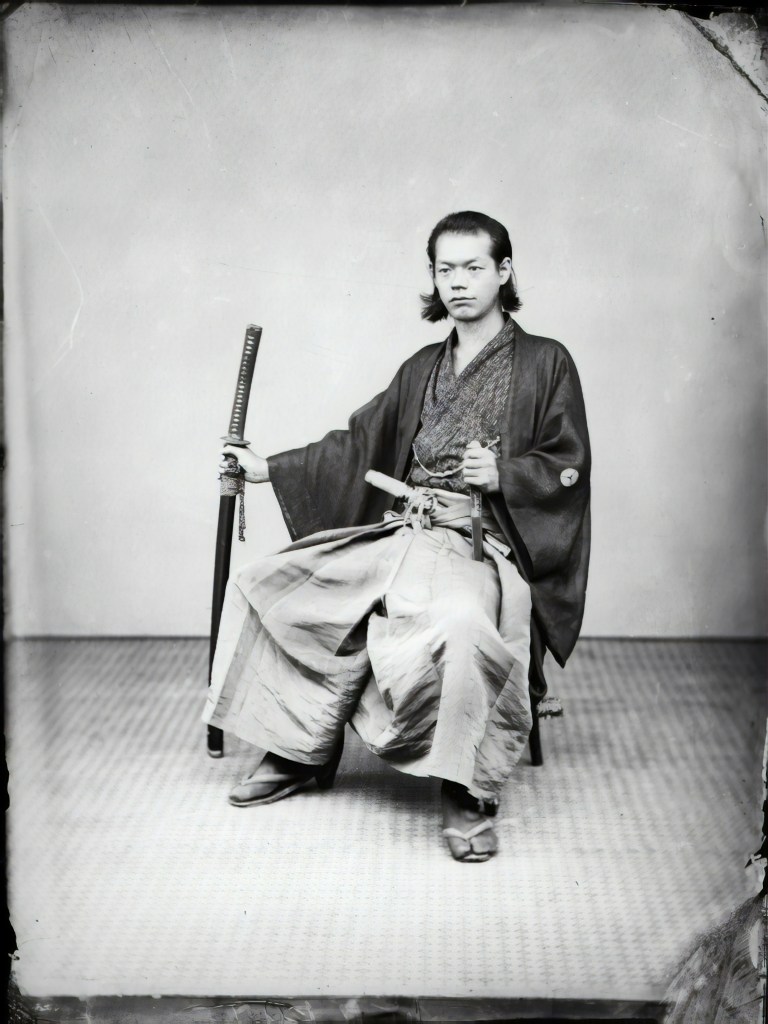
The solution came in the form of a garment previously reserved for men: the hakama. Traditionally worn by samurai, Shinto priests, and other men of status, the hakama was a symbol of formality, discipline, and masculinity. As women entered the public sphere through education, reformers and educators sought a school uniform that would both reflect the spirit of modern learning and accommodate the practical demands of daily school life.

A young Okuma Shigenobu who would later become prime minister of Japan (1868). Source: Wikimedia.
Man in a hakama ensemble sitting on a chair. Source: Austrian National Library on Unsplash.

Rather than simply adopting Western school uniforms, which were gaining popularity at the time, Japan developed its own hybrid style. The hakama was adapted specifically for female students by reworking the traditional menโ€™s trouser-style version (umanori hakama, ้ฆฌไน—ใ‚Š่ขด) into a wider, skirt-like variation. This new form offered greater freedom of movement, making it suitable not just for sitting in class or walking to school, but also for participating in physical education.

At the same time, the skirted hakama was seen as preserving a sense of feminine decorum. It allowed girls to move more freely than a formal kimono would permit, without crossing the gender boundaries associated with wearing trousers. Proponents argued that this combination struck the right balance between modern utility and traditional modesty.

By 1898, this modified version of the hakama had become a standard uniform at many girlsโ€™ schools, particularly elite and state-sponsored institutions such as the Womenโ€™s Higher Normal School (ๅฅณๅญ้ซ˜็ญ‰ๅธซ็ฏ„ๅญฆๆ ก), now Ochanomizu University (ใŠ่Œถใฎๆฐดๅฅณๅญๅคงๅญฆ), in Tokyo. The ensemble typically included a long-sleeved furisode kimono in a bold pattern, a white or light-colored blouse with a stand-up collar (sometimes with Western-style influences), and lace-up boots or leather shoes; an outfit that visually merged Japanese tradition with modern sensibilities.

A group of female students and their teachers during the Womenโ€™s Higher Normal School establishment in 1875. Source: Ochanomizu University‘s website.

This new school uniform became a powerful visual symbol of progress, self-discipline, and national pride. It represented a forward-thinking generation of young women who were being educated not just for domestic life, but also as contributors to a rapidly modernising Japan. And for the students themselves, wearing the hakama was more than a dress code; it was a badge of honor, marking them as part of a new social vanguard.

Manga, Modern Girls, and the Legacy of Haikara-san

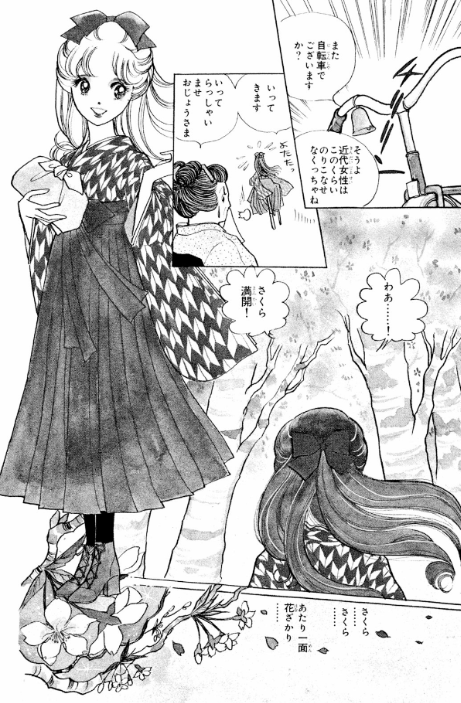
A well-known example of the hakama look in popular culture is the shลjo manga Haikara-San: Here Comes Miss Modern (Haikara-san ga Tลru; ใฏใ„ใ‹ใ‚‰ใ•ใ‚“ใŒ้€šใ‚‹) by Waki Yamato, serialised between 1975 and 1977. Set in Tokyo during the early 20th century, the story follows spirited and headstrong schoolgirl Benio Hanamura, who refuses to conform to the societal expectations of her time.

Cover picture of ใฏใ„ใ‹ใ‚‰ใ•ใ‚“ใŒ้€šใ‚‹ (1975-77) by Waki Yamato.
Panel on page 6 of ใฏใ„ใ‹ใ‚‰ใ•ใ‚“ใŒ้€šใ‚‹ (1975-77) by Waki Yamato.

Benio loves Western fashion, reads novels, rides horses and bicycles, fences, and dreams of becoming a journalist rather than marrying young, as her family expects. Her iconic outfit, a long-sleeved furisode kimono with a bold yabane (็Ÿข็พฝ, arrow-feather) pattern symbolising determination, paired with a wide hakama, lace-up boots, and long flowing hair tied with a large ribbon, perfectly captures the spirit of the haikara movement. Benio was not just a character; she became a visual icon and role model for generations of readers drawn to her image of modern, independent womanhood.

Benioโ€™s look also reflects broader societal changes taking place at the time. The bicycle, a potent symbol of mobility and independence in early 20th-century Japan, had become a popular means of transportation among young women. In fact, Benio is famously introduced in the second scene of Haikara-san ga Tลru riding her bicycle through the streets of Tokyoโ€”wind in her hair, hakama flowingโ€”visually establishing her as a modern, active heroine from the start. The wide pleats of the hakama allowed for comfort, dignity, and freedom of movement. Paired with lace-up boots, Benioโ€™s outfit wasnโ€™t just stylish; it was practical and emblematic of a generation of women embracing education, autonomy, and a new visual language of modern femininity.

The Hakama Today: Tradition, Empowerment, and Graduation Style

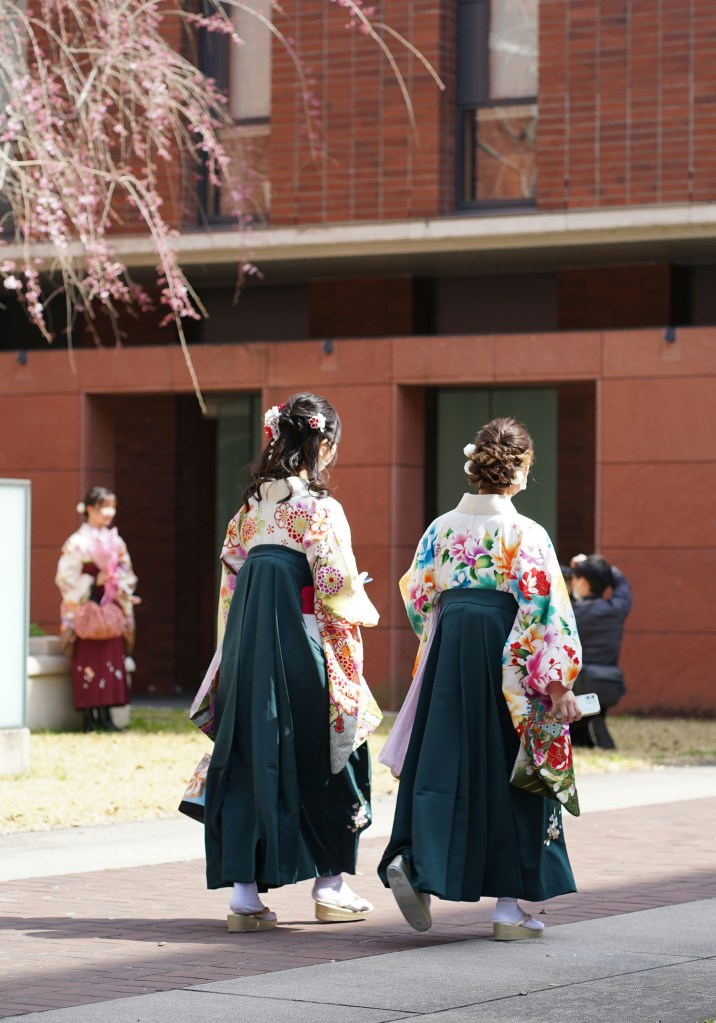
Today, this symbolism is still alive, especially during sotsugyล-shiki (ๅ’ๆฅญๅผ), the Japanese university graduation ceremony. For many young women, choosing to wear the traditional hakama-and-kimono combination on this day is more than a nod to the past; it is a meaningful, personal statement. The outfit represents a milestone marking not only academic achievement but also a further step into adulthood and a new chapter in life.

A young woman during her university graduation ceremony. Source: Shika Chen on Unsplash.
Young women during their universiry graduation. Source: Yosuke Ota on Unsplash.

The graduation hakama is often worn with a brightly colored long-sleeved furisode kimono, a style once associated with unmarried women and formal occasions. Popular motifs include plum blossoms, cranes, or geometric patterns like yabane, all of which carry auspicious meanings. The garments are usually rented from specialty shops that offer styling, dressing, and photography packages specifically for the big day.

Wearing the hakama today allows graduates to visually connect with a lineage of educated women before them. It recalls the pioneering students of the Meiji and Taishล eras who broke social barriers and helped redefine the role of women in Japanese society. By stepping into this attire, contemporary graduates symbolically align themselves with that spirit of courage, discipline, and forward momentum.

Even outside of formal ceremonies, the hakama continues to appear in cultural contexts; from coming-of-age photoshoots and weddings to cosplay and historical reenactments. While its meanings have diversified, its association with education, empowerment, and female agency remains particularly strong. The hakama is therefore not just a relic of school uniforms past; itโ€™s a living garment that still speaks volumes about identity, ambition, and the ongoing dialogue between tradition and change.


A shortened German version of this article was published on JAPANDIGEST: https://www.japandigest.de/kulturerbe/brauch/kimono/hakama-frauen/.

Exploring Japanese Theater: Nล and Kabuki at Cool Japan 2025 in Hamburg

Back in March, I had the pleasure of curating and moderating the event โ€œCool Japan 2025 โ€“ Japanese Theater from Nล to Kabukiโ€ at the Museum am Rothenbaum โ€“ Kulturen und Kรผnste der Welt (MARKK) in Hamburg.

The one-day event offered a rich, multi-sensory exploration of historical and contemporary Japanese performing arts. With a diverse programme tailored to both children and adults, visitors could take part in creative workshops, guided exhibition tours, academic talks, and live performances which were all designed to bring Japanese theater traditions closer to a broad audience.

Stories in Masks and Makeup

The programme opened with a lecture by Prof. Annegret Bergmann titled โ€œAn Introduction to Japanese Theater.โ€ In this talk, she offered valuable historical and aesthetic context for Nล and Kabuki, giving the audience a solid foundation for understanding the performances and objects featured throughout the day.

Later, she returned with a second, more focused lecture on the symbolism and staging of Kabuki makeup, known as kumadori (้šˆๅ–). Far from being mere decoration, these bold lines and colours communicate essential traits of a character – strength, virtue, rage, or deception – and are deeply intertwined with the dramatic rhythm and emotional charge of Kabuki theater. Her insights made it clear that makeup in Kabuki is not just worn; it is performed.

Complementing her talk was a display of curated objects from the MARKKโ€™s own collection, giving attendees a rare glimpse into the material culture of Japanese theater. Items on view included authentic nล masks, makeup utensils, decorative accessoires such as hair pins, and kabuki-themed ukiyo-e prints. Together, they offered a tactile connection to performance traditions that have shaped Japanese cultural identity for centuries.

Another key moment in the program was the screening of the Kabuki classic Yoshitsune and the Thousand Cherry Trees (็พฉ็ตŒๅƒๆœฌๆกœ, Yoshitsune Senbon Zakura), a beloved tale of loyalty, disguise, and fate. Before the screening, Mr. Shinsuke Toda, Consul General of Japan in Hamburg, addressed the audience with warm words that reflected on the richness of Japanese stage tradition and its resonance far beyond Japanโ€™s borders.

Contemporary Echoes: Chihoco Yanagiโ€™s Journey Through Dance

Dancer and choreographer Chihoco Yanagi performed twice during the event, showcasing two distinct forms of Japanese dance and offering the audience a powerful glimpse into both tradition and innovation.

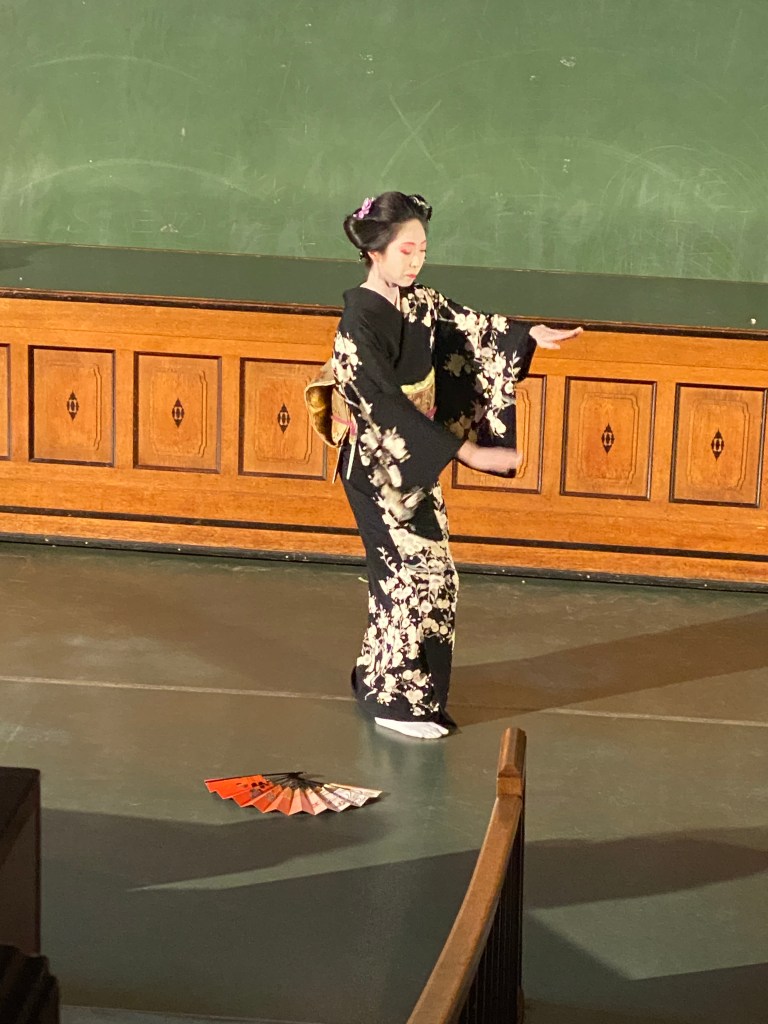
Her first performance was a traditional Nihon Buyล (ๆ—ฅๆœฌ่ˆž่ธŠ) piece, an elegant, stylised form of Japanese stage dance that draws from classical theater traditions of Kabuki and Nล. Performed in kimono and often accompanied by shamisen music, Nihon Buyล combines graceful movement with storytelling gestures that reference nature, seasonal change, and human emotion. Chihoco’s precise, flowing choreography and expressive presence brought this refined tradition vividly to life.

Later in the day, Chihoco returned to the stage with a series of contemporary Shin Buyล (ๆ–ฐ่ˆž่ธŠ) pieces. Shin Buyล, or โ€œnew dance,โ€ emerged in the 20th century as a modern evolution of traditional Japanese dance forms. While it often preserves the structure and vocabulary of classical styles, it embraces greater freedom, allowing for modern music, expressive experimentation, and personal themes.

One of these pieces was set to live music performed by musicians from the Laeiszhalle Akademie, featuring Antonรญn Dvoล™รกkโ€™s American Quartet. This particular performance stood out for its deeply autobiographical tone. Drawing on her own experience of leaving Japan and adapting to a new cultural environment, Chihoco expressed themes of longing, excitement, disorientation, and liberation through a nuanced choreography.

As someone who has lived in several countries myself, I found this piece especially moving. Her gestures, at once searching and composed, articulated a kind of emotional geography I knew well: the shifting terrain between memory and discovery, between where we come from and where we imagine ourselves becoming.

Dressing for the Kabuki

To mark the occasion, I chose to wear a vintage purple komon kimono I had found during a trip to Japan the previous November. It was the first time I wore it, and together with my fellow kimono nerd and illustrator friend Sophie, we had previously experimented with different obi styles to find one that reflected the spirit of kabuki: expressive, playful, a little bold.

Unfortunately, I couldnโ€™t quite recreate the knot on the day of the event as beautifully as we had done together but it was still fun to experiment, and it added a personal layer of creativity to the day. In its own small way, it was also a performance: a gesture of cultural appreciation, memory, and imagination folded into fabric.

It felt especially meaningful to share the day with friends who are also engaged with Japanese textile culture in their own ways. My friend Mana, for instance, recently founded Hansa Kimono, a small business through which she curates and sells vintage haori (kimono jackets) here in Hamburg. Our shared passion for making traditional Japanese garments accessible and wearable in everyday life adds yet another layer to how these textiles continue to live, travel, and evolve across cultures.

Final Reflections

โ€œCool Japan 2025โ€ was more than a themed event; it was an exploration of cultural expression across generations, media, and stages. Through movement, music, objects, and storytelling, the day offered a window into the deep roots and evolving forms of Japanese theater.

From Nล masks to Kabuki fans, from classic dance to modern choreography, each element provided a different point of entry into a living tradition. For me, it was not only an opportunity to help shape the programme, but also to participate in it through dress, dialogue, and shared appreciation.

The museumโ€™s historic lecture hall offered a fitting stage for it all: its wood paneling, raised platform, and slightly timeworn elegance lent the performances a quiet grandeur; one that mirrored the layers of history embedded in the art forms themselves.

And like any good performance, the echoes of the day continue to resonate… but more on this another time ๐Ÿ˜‰

Why Did I Go to Japan? Discussing Kimono on Japanese TV

It just recently occured to me that I never talked about my appearance on TV Tokyoโ€™s well-known show Why Did YOU Come to Japan? (YOUใฏไฝ•ใ—ใซๆ—ฅๆœฌใธ๏ผŸ) on this blog. Iโ€™m not quite sure what kept me from writing about it before, but here is me aiming to change that.

This article is 720 words long.
๐Ÿ•’ Estimated reading time: 4 minutes.

For those unfamiliar with the show, Why Did YOU Come to Japan? follows the journeys of international visitors to Japan, often starting with spontaneous interviews at the airport. The programmeโ€™s crew approaches travelers to ask about their plans, hoping to uncover unique and meaningful stories.

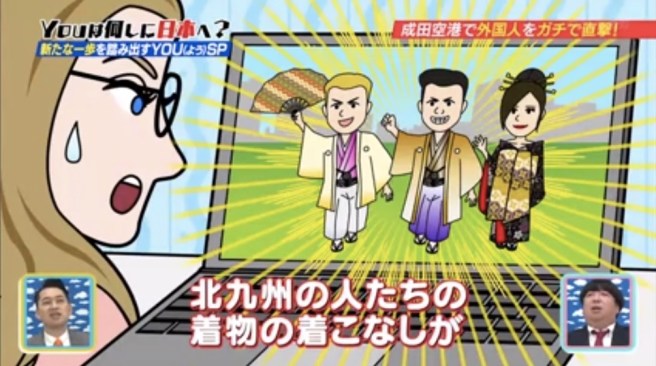
I was one such traveler, approached by the crew at Kansai Airport in February 2018, just as I was arriving for a six-month stay to conduct PhD fieldwork. The crew followed me over three full days, capturing glimpses of my daily life as a researcher in Japan. While many scenes didnโ€™t make the final cut, the broadcast focused on my research visit to the shop MIYABI in Kitakyushu.

Miyabi Ikeda, the owner of kimono shop MIYABI.
Me during an interview with Miyabi-san.

The shop MIYABI is renowned in Kitakyushu as a popular destination for the local Seijin-Shiki (ๆˆไบบๅผ), or Coming-of-Age Ceremony. This annual event celebrates young adults reaching the age of then 20, now 18, marking their transition to adulthood. Kitakyushuโ€™s ceremony, in particular, is famous across Japan for its attendeesโ€™ incredibly inventive attireโ€”each year, many invest a significant amount into crafting unforgettable outfits that reflect personal style and hometown pride.

A female attendee of Kitakyushu’s coming-of-age ceremony in 2015.
A male attendee of Kitakyushu’s coming-of-age ceremony in 2016.

Although I didnโ€™t get to attend the ceremony itself or interview the young adults firsthand, my visit to MIYABI provided valuable insight into these unique local customs. The shopโ€™s owner, Miyabi Ikeda, shared stories of her experiences and the elaborate preparations that go into helping customers create statement outfits for this important day. Through her perspective, I gained a deeper appreciation for the cultural significance and creativity surrounding Kitakyushuโ€™s Coming-of-Age Ceremony.

The distinctive styles of the hade hakama (ๆดพๆ‰‹่ขด) for men and oiran kitsuke (่Šฑ้ญ็€ใ‘) for women served as key inspirations for Chapter 6 of my PhD dissertation, Challenging Normative Gender Ideals? Alternative Forms of Coming-of-Age Dress. In this chapter, I examine how these bold styles transcend conventional norms to allow unique expressions of identity. For those interested, my full dissertation can be accessed here: Becke, Carolin (2022) Negotiating Gendered Identities Through Dress: Kimono at the Coming-of-age Day in Contemporary Japan.

A summary of the TV episode discussing these styles is also available in Japanese on the programmeโ€™s website: Why Did YOU Come to Japan? – Episode 180730. For a closer look at MIYABI’s most recent creations, I recommend following their Instagram account: @miyabi_kokura.

Reflecting on this experience, Iโ€™m reminded of how unexpected encounters can shape and enrich our journeys in ways we donโ€™t anticipate. Being part of Why Did YOU Come to Japan? gave me a unique opportunity to share my research with a broader audience and connect with Japan from a new perspective. It captured not only the purpose of my fieldwork but also the warmth and curiosity that I encountered throughout my time there. I hope this glimpse into my journey offers you some insight into the fascinating intersections of research, culture, and the unexpected surprises that make travel so rewarding.


Ukiyo-e (ๆตฎไธ–็ตต) Woodblock Prints: Urban Pleasures in Edo Japan

Woodblock prints known as ukiyo-e (ๆตฎไธ–็ตต, โ€œpictures of the floating worldโ€) offer a vivid glimpse into the everyday pleasures and cultural life of Edo-period Japan. Far from being elite art, these prints reflected the tastes and pastimes of the emerging merchant class; urban dwellers who, despite their low social status, became the driving force behind a flourishing world of fashion, performance, and entertainment. This article explores how ukiyo-e captured the spirit of the so-called โ€œfloating worldโ€ and the lives of its most iconic figures.

This article is 810 words long.
๐Ÿ•’ Estimated reading time: 4โ€“5 minutes.

Woodblock prints called ukiyo-e became a popular art form during Japan’s Edo period (1603-1868). Their depictions were closely tied to the cultural practices cultivated by chลnin (็”บไบบ), members of the merchant class, who emerged as the patreons of Edo’s urban entertainment and culture.

While the shogunate formed the politicial authority of the time, the merchant class became more and more dominant in influencing urban culture in the thriving economic centres of Edo (former Tokyo), Osaka and Kyoto. This created quite a bit of tension, however; the social hierarchy envisioned by the shogunate was based on Confucian values and cast merchants as part of the lowest class. This was based on the assumption that merchants did neither use mind (like scholars) nor muscles (like farmers and artisants) to produce something of ‘value’ but were rather, in their ‘excessive accumulation of wealth’, a threat and disturbance to the social order.

‘The Prosperty of the Four Classes’, Utagawa Kunisai, 1869.

This low, social position was contrasted with the growing financial means and, therefore, cultural influence which the chลnin managed to accumulate during the course of the 17th century. While the shogunate followed rationalistic Neo-Confucian principles, the merchant class was guided by the hedonistic celebration of the ‘floating world’ (ๆตฎไธ–, ukiyo). This term describes the transient, unreliable world into which one is born into but aims to escape through Buddhist practices such as meditation and abstinence. Edo’s merchants turned this believe on it’s head not by resisting but rather celebrating and seeking out everyday forms of pleasure and entertainment.

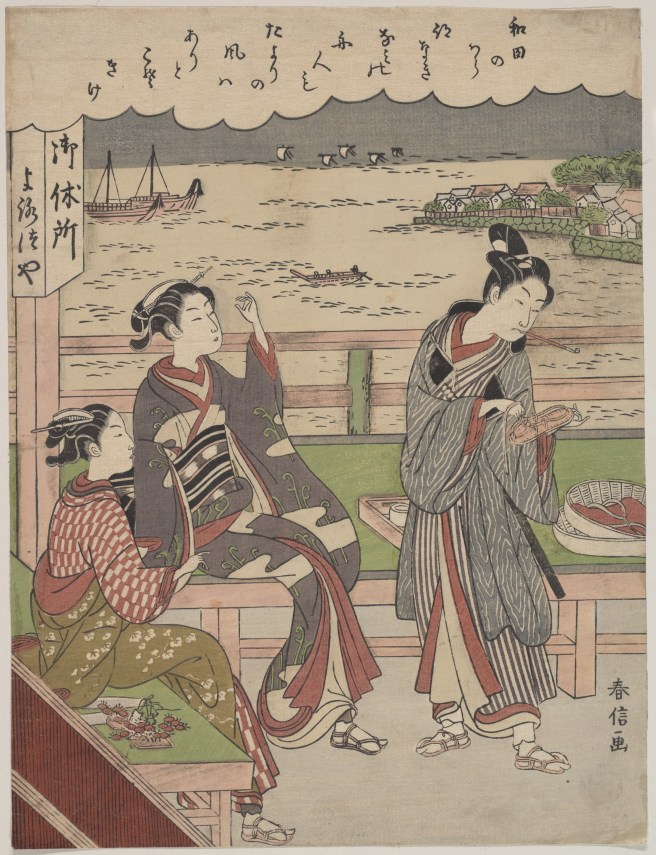
Ukiyo-e woodblock prints became a means to visually capture the varied amusements of the ‘floating world’. Special occassions such as appreciating the seasonal flowers in a nearby temple garden were equally depicted as were the occassional visit to a local sentล (้Šญๆนฏ, bathing house). Travel scenes and popular spots aimed to inspire touristic journeys while well-known scenes from folk tales and history served as everyday entertainment. In terms of human subjects, beautiful and stylish men and women, represented most commonly by kabuki actors and courtesans, were equally among the favoured subjects ofukiyo-e artists. Being clad in the latest fashion and/or showing off their personal style, actors and courtesans became trend setters for dress and design through these easily distributed prints.

‘A Man and Two Women at a Teahouse at Wada no Ura Overlooking the Sea’, Harunobu Suzuki, 1750s.
‘The Courtesan Hanaลgi of the ลŒgiya’, Ichirakutei Eisui, 1790s.

Another popular but slightly less often discussed cultural figure was the cha-ya musume (่Œถๅฑ‹ๅจ˜, literally ‘teahouse daugther’). Having a tea and some snacks at a cha-ya was a popular leisure activity. While these establishments were often run by elderly couples, the tactic to employ young, attractive women to serve tea and have a bit of a chat with customers quickly became a marketing strategy.

A quite famous cha-ya musume was Naniwaya Okita (้›ฃๆณขๅฑ‹, born 1778), who was a female employee of a cha-ya located close to the famous Buddhist temple Sensล-ji. She became one of the favourite subjects of ukiyo-e artist Kitagawa Utamaro, whom he enshrined as one of the ‘three beauties of the present day’ in a print of the same name. Due to the fame she gained through the prints, Okita became the ‘poster girl’ of the shop, with some customers believed to travel far and white for a glimpse of this fair young lady.

‘Naniwaya Okita’, Kitagawa Utamaro, 1793.
‘Three Beauties of the Present Day’, Kitagawa Utamaro,1792โ€“93.

By studying ukiyo-e, we can learn a lot about the popular culture which was built on the hedonistic practices and preferences of the urban working classes of Edo Japan. With their love for entertainemt and fun, they were an annoyance to the ruling shogunate, but created a culture which many of us still can relate to today.

Eine deutsche Version des Artikels findet ihr auf JAPANDIGEST: https://www.japandigest.de/kulturerbe/geschichte/kunsthandwerk/ukiyo-e/

An Introduction to Kimono Styles of Japanโ€˜s Taisho Period (1912-26): The Taisho Roman Style of Female Students

At the intersection of East and West, tradition and innovation, the Taishล period (1912โ€“1926) saw the emergence of bold new kimono styles that reflected Japanโ€™s rapidly changing society. Known as Taishล Roman, this aesthetic blended romantic ideals, Western influences, and a playful reinterpretation of traditional dress. In this article, I revisit a demonstration I co-hosted with Sonoe Sugawara of Furuki Yo-Kimono Vintage, where we introduced the unique look of the Taishล Roman schoolgirl, complete with high-collared blouses, red hakama, and vibrant, eye-catching kimono.

This article is 860 words long.
๐Ÿ•’ Estimated reading time: 4โ€“5 minutes.

At the Yokimono Japanese Christmas Market in December 2022, I collaborated with my good friend Sonoe Sugawara of Furuki Yo-Kimono Vintage on a demonstration and talk of Taisho period kimono styles. This turbulent era gave birth to some eclectic kimono styles which were based on a new approach towards Japanese and Western modes of dress. One of the styles we introduced was the Taisho Roman (ๅคงๆญฃใƒญใƒžใƒณ) style of female students.

Sonoe demonstrated how to recreate the so-called ‘Taisho Roman‘ style, also known as the hai-kara style, with a 1920s silver and purple vintage kimono and red hakama from her shop.

In general, Taisho Roman (ๅคงๆญฃๆตชๆผซ, or ๅคงๆญฃใƒญใƒžใƒณ) refers to the ideals of romanticism which were expressed by a quirky reinterpretation of traditional culture during this time. Kimono of this decade often featured flowing, asymmetrical designs, with playful and whimsical motifs such as flowers, birds, and butterflies. It was also common to see the use of luxurious fabrics such as silk and satin, and the incorporation of Western-style elements such as lace and embroidery. The Taisho Roman kimono style became known for its bright colours and bold, graphic patterns such as the yabane (็Ÿข็พฝ, arrow feathers) pattern.

Yabane pattern in purple. Image Source: nippon.com

The word hai-kara (ใƒใ‚คใ‚ซใƒฉใƒผ) derives from the word ‘high collar’ on the other hand and refers to the, for Japanese eyes, unusual collar style of shirts of this time. Victorian-style blouses became popular with young Japanese women of the middle class who wore these as undergarments, with the collar and cuffs peaking out under the kimono. The term also more generally meant ‘to dress in the latest western fashion‘ which demonstrates the fashion-forward way of thinking of these young women.

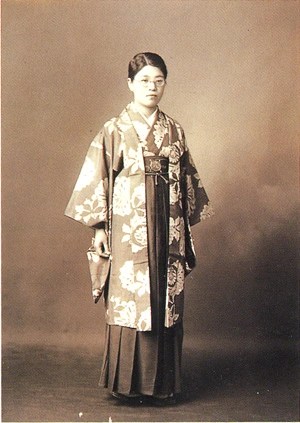
Besides blouses, women started to adopt hakama which were previously exclusively reserved for men. With more women entering education, female students were in need of a uniform which allowed them to participate in all school activities on the same level as the boys. Debates on movement and the body resulted in the decision to modify menโ€˜s hakama trousers by turning them into hakama skirts for young women.

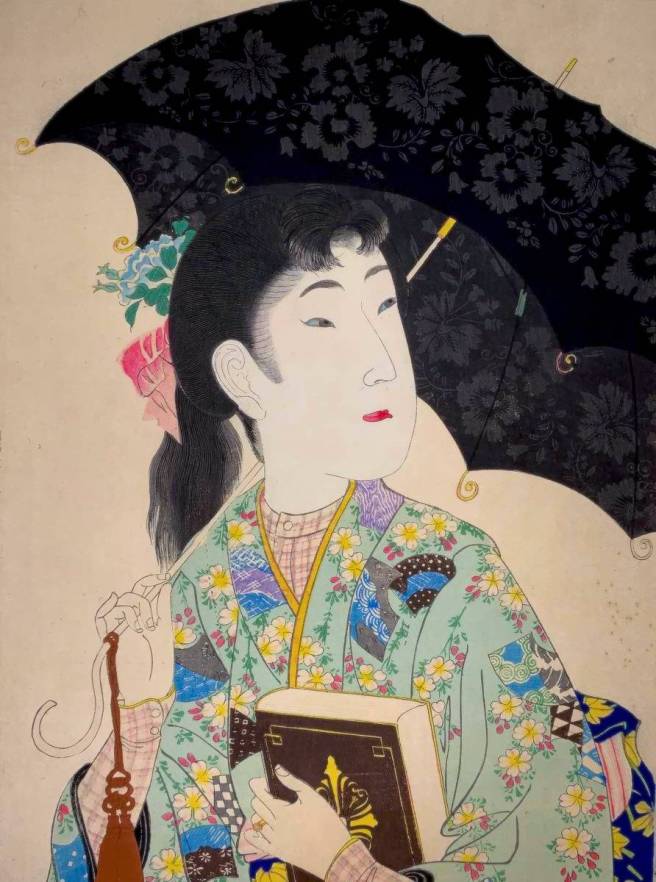
Toyohara Chikanobu (ๆฅŠๆดฒๅ‘จๅปถ),ใ€Œ็œŸ็พŽไบบใ€€ๅๅ››ใ€€ๆด‹ๅ‚˜ใ‚’ใ•ใ™ๅฅณๅญฆ็”Ÿใ€(Meiji 30, 1897).
ยฉ ลŒta Memorial Museum of Art (ๅคช็”ฐ่จ˜ๅฟต็พŽ่ก“้คจ), Tokyo.
Young women wearing a short skirt, umbrella and lace shoes. Source unknown.

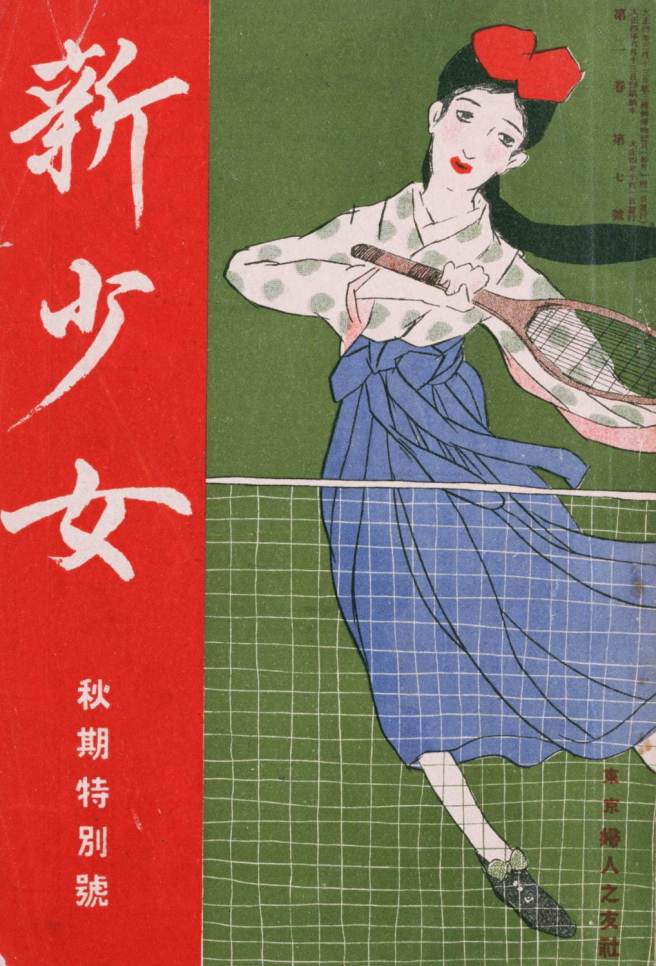
This hakama style was considered to allow for unrestricted movements of the hip and legs. This was particular important in a time when physical education became part of the school curriculum, and sports of all kinds became popular leisure activities. Shoes also played a part in this, with the traditional sandal footwear of geta being replaced by lace shoes and boots. The new mode of transportation, the bicycle, became favoured and later representative of the forward-thinking young men and women who were considered to built a bright future for the Japanese nation.

Yumeji Takehisa (็ซนไน…ๅคขไบŒ), โ€˜Tennisโ€™ (post-1900s).
Female student wearing a meisen kimono and haori combined with a womenโ€˜s hakama. Source unknown.

Another popular reference of the style is the manga Haikara-San: Here Comes Miss Modern (ใฏใ„ใ‹ใ‚‰ใ•ใ‚“ใŒ้€šใ‚‹ haikara-san ga tลru, 1975-77) by Waki Yamato. The manga that tells the story of Benio Hanamura, a young woman living in Tokyo in the 20th century. Benio is laballed as a โ€˜tomboyโ€˜ with a big interest in Western culture and fashion. This sets her apart from and often creates a conflict with the more conservative Japanese women of her time. As a female student, she often wears a yabane-patterned furisode kimono and hakama combination as depicted below.

Cover picture of ใฏใ„ใ‹ใ‚‰ใ•ใ‚“ใŒ้€šใ‚‹ (1975-77) by Waki Yamato.
Panel on page 6 of ใฏใ„ใ‹ใ‚‰ใ•ใ‚“ใŒ้€šใ‚‹ (1975-77) by Waki Yamato.

Overall, the Taisho Roman kimono style was a reflection of the era’s fascination with modernity, individualism, and self-expression, and represented a departure from the more rigid and feminine conservative styles that had come before it.

Cardiff-Japanese Lecture Series: ‘Kimono (and) Fashion in Japan’

This online public lecture titled ‘Kimono (and) Fashion in Japan’ is part of the Cardiff-Japanese Lecture Series which aims to explore and understand aspects of language learning for those studying Japanese language and culture at Cardiff University, as well as various learners, teachers and researchers with an interest in Japan. The event is funded by the Japan Foundation, London.

Abstract
Both inside and outside of Japan, kimono is commonly framed as the national costume of Japan, bestowing the garment with notions of tradition and stability. However, ever since the establishment of a widespread fashion system in the Edo period (1603-1868), kimono was worn in different ways to communicate individual and social characteristics such as status, occupation, gender and taste.

This talk sheds some light on the fashionable influences on the garment by examining the following questions; how was kimono marketed by members of the merchant class, who became affluent during the Edo period? In which way did the moga (ใƒขใ‚ฌ, โ€˜modern girlsโ€™) of the Taisho period (1912-1926) wear the garment? How is the retro style, which gained prominence due to magazines such as Kimono Hime (Shลdensha, 2003-2018) and Kimono Anne (TAC Shuppan, 2019-), connected to the popularity of kimono as an everyday garment in recent decades?

Watch the recording of the lecture to find out more!