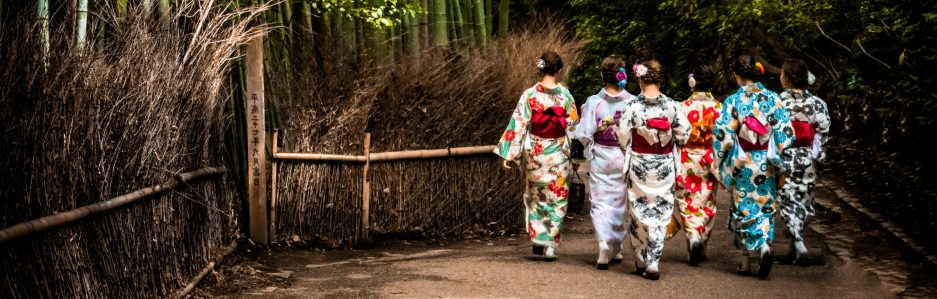
When attending a university graduation ceremony in Japan, you’ll likely see young women dressed in a traditional garment called the hakama; a wide, pleated lower garment worn over a kimono. While today it’s closely associated with academic achievement and coming of age, the hakama was originally a piece of clothing worn only by men. So how did it become a symbol of female empowerment and education? In this article, we explore the fascinating journey of the hakama, from its roots in samurai culture to its enduring role in Japanese school traditions and graduation ceremonies.
This article is 1,850 words long.
🕒 Estimated reading time: 8 minutes.

Education Reform and the Rise of the Japanese Schoolgirl
During the Meiji era (1868–1912), Japan underwent a period of intense modernisation and nation-building. Determined to compete with the Western powers and shed its feudal image, the country launched sweeping reforms across all areas of society, from government and industry to infrastructure and education. Central to this transformation was the creation of a strong, literate, and disciplined population capable of supporting a modern state. Education, therefore, became one of the most important tools for shaping Japan’s future.
While education had long been available to boys of samurai and merchant families, the Meiji government now sought to create a national, standardized school system modeled in part on European systems. The 1872 Education System Order (gakusei, 学制) laid the foundation for universal education, and by the 1880s and 90s, the number of schools, and students, was growing rapidly.
Initially, girls’ education lagged behind. Early on, many believed that education for women should be limited to moral instruction and domestic skills to prepare them for their roles as ‘good wives, wise mothers’ (ryōsai kenbo, 良妻賢母). However, as the state increasingly realised the broader importance of women in shaping the home and, by extension, the nation, more formal academic opportunities opened up for girls.
But alongside these ideological changes came a very practical issue: what should female students wear to school? The traditional kimono, while elegant, was considered by some as unsuited to the demands of the classroom. Long sleeves got in the way of writing or handling materials, and the layered fabric restricted movement, especially during increasingly popular activities like group gymnastics or walking commutes to school.
Educators and reformers began looking for a uniform that offered both mobility and modesty. The goal was to find clothing that allowed young women to participate fully in a modern education without appearing inappropriate or overly ‘Westernised’. This opened the door for the hakama, a garment that would soon become the visual hallmark of the educated, forward-looking Japanese schoolgirl.
From Samurai Uniform to Student Dress: How the Hakama Was Reimagined
The solution came in the form of a garment previously reserved for men: the hakama. Traditionally worn by samurai, Shinto priests, and other men of status, the hakama was a symbol of formality, discipline, and masculinity. As women entered the public sphere through education, reformers and educators sought a school uniform that would both reflect the spirit of modern learning and accommodate the practical demands of daily school life.

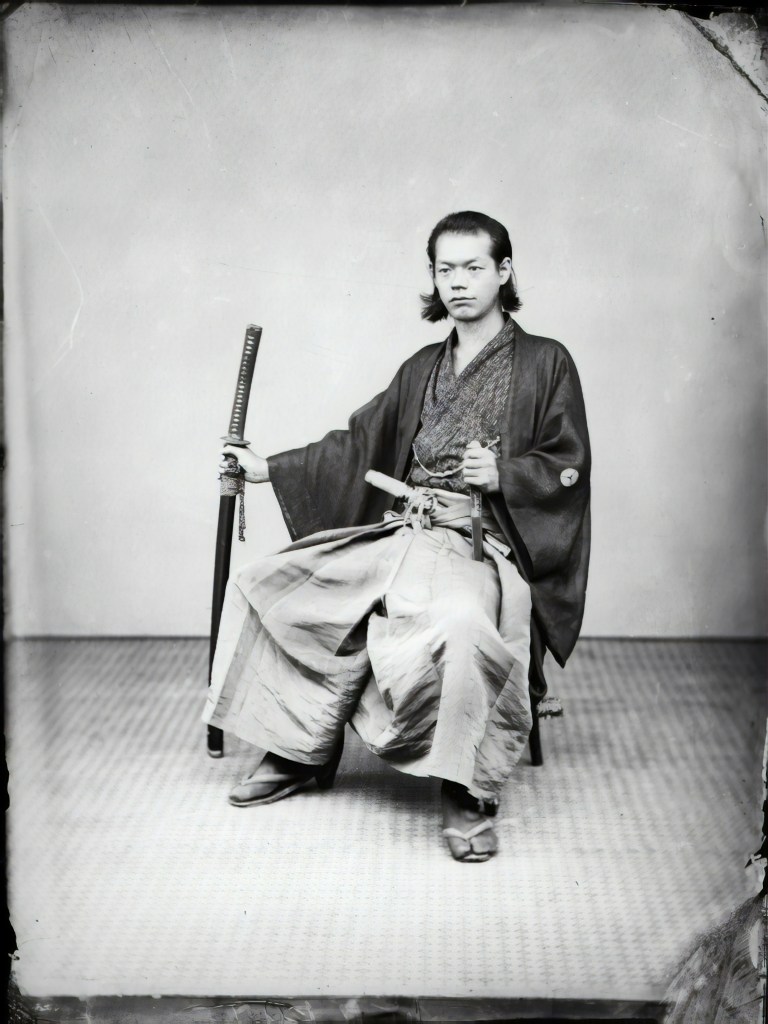
Rather than simply adopting Western school uniforms, which were gaining popularity at the time, Japan developed its own hybrid style. The hakama was adapted specifically for female students by reworking the traditional men’s trouser-style version (umanori hakama, 馬乗り袴) into a wider, skirt-like variation. This new form offered greater freedom of movement, making it suitable not just for sitting in class or walking to school, but also for participating in physical education.
At the same time, the skirted hakama was seen as preserving a sense of feminine decorum. It allowed girls to move more freely than a formal kimono would permit, without crossing the gender boundaries associated with wearing trousers. Proponents argued that this combination struck the right balance between modern utility and traditional modesty.
By 1898, this modified version of the hakama had become a standard uniform at many girls’ schools, particularly elite and state-sponsored institutions such as the Women’s Higher Normal School (女子高等師範学校), now Ochanomizu University (お茶の水女子大学), in Tokyo. The ensemble typically included a long-sleeved furisode kimono in a bold pattern, a white or light-colored blouse with a stand-up collar (sometimes with Western-style influences), and lace-up boots or leather shoes; an outfit that visually merged Japanese tradition with modern sensibilities.

This new school uniform became a powerful visual symbol of progress, self-discipline, and national pride. It represented a forward-thinking generation of young women who were being educated not just for domestic life, but also as contributors to a rapidly modernising Japan. And for the students themselves, wearing the hakama was more than a dress code; it was a badge of honor, marking them as part of a new social vanguard.
Manga, Modern Girls, and the Legacy of Haikara-san
A well-known example of the hakama look in popular culture is the shōjo manga Haikara-San: Here Comes Miss Modern (Haikara-san ga Tōru; はいからさんが通る) by Waki Yamato, serialised between 1975 and 1977. Set in Tokyo during the early 20th century, the story follows spirited and headstrong schoolgirl Benio Hanamura, who refuses to conform to the societal expectations of her time.


Benio loves Western fashion, reads novels, rides horses and bicycles, fences, and dreams of becoming a journalist rather than marrying young, as her family expects. Her iconic outfit, a long-sleeved furisode kimono with a bold yabane (矢羽, arrow-feather) pattern symbolising determination, paired with a wide hakama, lace-up boots, and long flowing hair tied with a large ribbon, perfectly captures the spirit of the haikara movement. Benio was not just a character; she became a visual icon and role model for generations of readers drawn to her image of modern, independent womanhood.
Benio’s look also reflects broader societal changes taking place at the time. The bicycle, a potent symbol of mobility and independence in early 20th-century Japan, had become a popular means of transportation among young women. In fact, Benio is famously introduced in the second scene of Haikara-san ga Tōru riding her bicycle through the streets of Tokyo—wind in her hair, hakama flowing—visually establishing her as a modern, active heroine from the start. The wide pleats of the hakama allowed for comfort, dignity, and freedom of movement. Paired with lace-up boots, Benio’s outfit wasn’t just stylish; it was practical and emblematic of a generation of women embracing education, autonomy, and a new visual language of modern femininity.
The Hakama Today: Tradition, Empowerment, and Graduation Style
Today, this symbolism is still alive, especially during sotsugyō-shiki (卒業式), the Japanese university graduation ceremony. For many young women, choosing to wear the traditional hakama-and-kimono combination on this day is more than a nod to the past; it is a meaningful, personal statement. The outfit represents a milestone marking not only academic achievement but also a further step into adulthood and a new chapter in life.

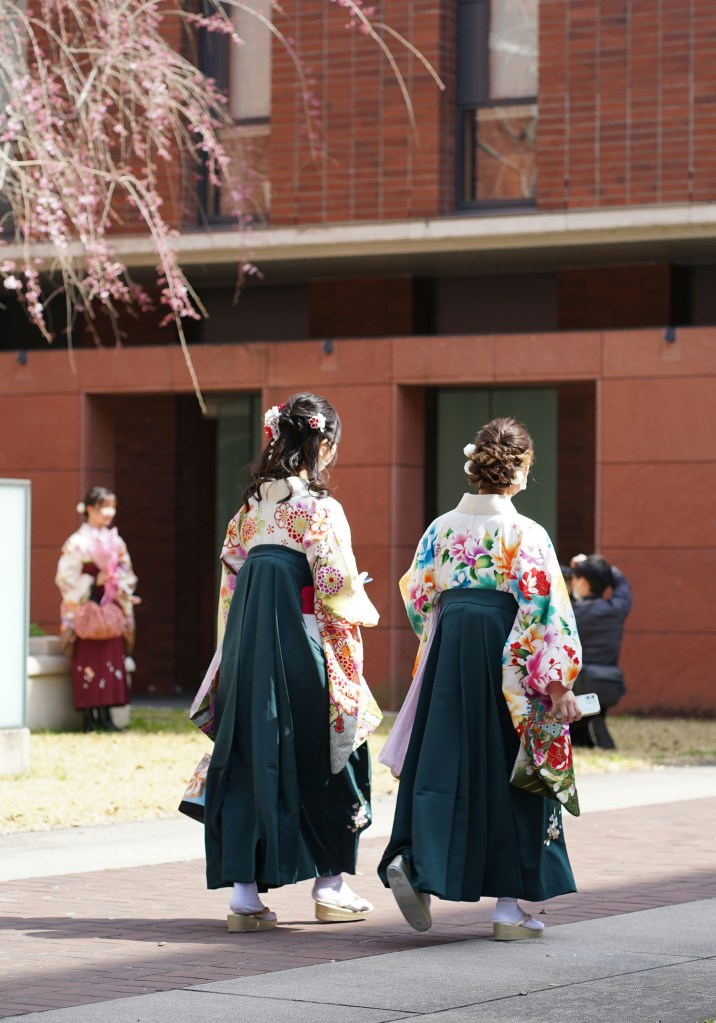
The graduation hakama is often worn with a brightly colored long-sleeved furisode kimono, a style once associated with unmarried women and formal occasions. Popular motifs include plum blossoms, cranes, or geometric patterns like yabane, all of which carry auspicious meanings. The garments are usually rented from specialty shops that offer styling, dressing, and photography packages specifically for the big day.
Wearing the hakama today allows graduates to visually connect with a lineage of educated women before them. It recalls the pioneering students of the Meiji and Taishō eras who broke social barriers and helped redefine the role of women in Japanese society. By stepping into this attire, contemporary graduates symbolically align themselves with that spirit of courage, discipline, and forward momentum.
Even outside of formal ceremonies, the hakama continues to appear in cultural contexts; from coming-of-age photoshoots and weddings to cosplay and historical reenactments. While its meanings have diversified, its association with education, empowerment, and female agency remains particularly strong. The hakama is therefore not just a relic of school uniforms past; it’s a living garment that still speaks volumes about identity, ambition, and the ongoing dialogue between tradition and change.
A shortened German version of this article was published on JAPANDIGEST: https://www.japandigest.de/kulturerbe/brauch/kimono/hakama-frauen/.

 DR CAROLIN BECKE