Why Did I Go to Japan? Discussing Kimono on Japanese TV

It just recently occured to me that I never talked about my appearance on TV Tokyo’s well-known show Why Did YOU Come to Japan? (YOUは何しに日本へ?) on this blog. I’m not quite sure what kept me from writing about it before, but here is me aiming to change that.

This article is 720 words long.
🕒 Estimated reading time: 4 minutes.

For those unfamiliar with the show, Why Did YOU Come to Japan? follows the journeys of international visitors to Japan, often starting with spontaneous interviews at the airport. The programme’s crew approaches travelers to ask about their plans, hoping to uncover unique and meaningful stories.

I was one such traveler, approached by the crew at Kansai Airport in February 2018, just as I was arriving for a six-month stay to conduct PhD fieldwork. The crew followed me over three full days, capturing glimpses of my daily life as a researcher in Japan. While many scenes didn’t make the final cut, the broadcast focused on my research visit to the shop MIYABI in Kitakyushu.

Miyabi Ikeda, the owner of kimono shop MIYABI.
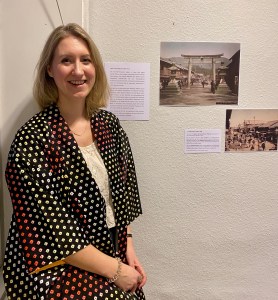
Me during an interview with Miyabi-san.

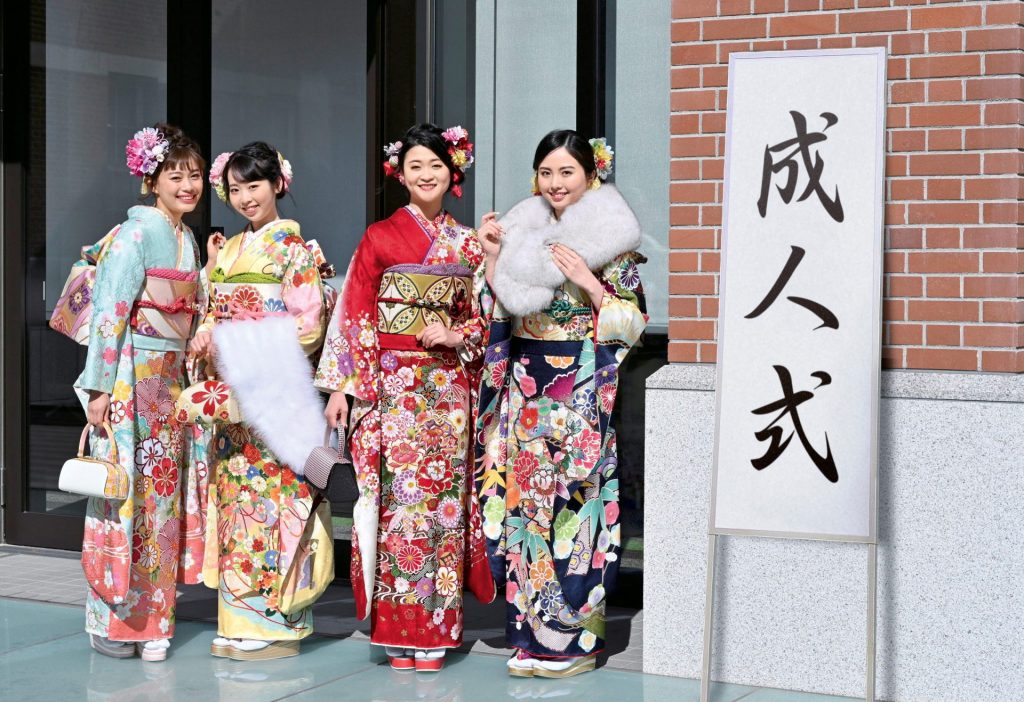
The shop MIYABI is renowned in Kitakyushu as a popular destination for the local Seijin-Shiki (成人式), or Coming-of-Age Ceremony. This annual event celebrates young adults reaching the age of then 20, now 18, marking their transition to adulthood. Kitakyushu’s ceremony, in particular, is famous across Japan for its attendees’ incredibly inventive attire—each year, many invest a significant amount into crafting unforgettable outfits that reflect personal style and hometown pride.

A female attendee of Kitakyushu’s coming-of-age ceremony in 2015.
A male attendee of Kitakyushu’s coming-of-age ceremony in 2016.

Although I didn’t get to attend the ceremony itself or interview the young adults firsthand, my visit to MIYABI provided valuable insight into these unique local customs. The shop’s owner, Miyabi Ikeda, shared stories of her experiences and the elaborate preparations that go into helping customers create statement outfits for this important day. Through her perspective, I gained a deeper appreciation for the cultural significance and creativity surrounding Kitakyushu’s Coming-of-Age Ceremony.

The distinctive styles of the hade hakama (派手袴) for men and oiran kitsuke (花魁着け) for women served as key inspirations for Chapter 6 of my PhD dissertation, Challenging Normative Gender Ideals? Alternative Forms of Coming-of-Age Dress. In this chapter, I examine how these bold styles transcend conventional norms to allow unique expressions of identity. For those interested, my full dissertation can be accessed here: Becke, Carolin (2022) Negotiating Gendered Identities Through Dress: Kimono at the Coming-of-age Day in Contemporary Japan.

A summary of the TV episode discussing these styles is also available in Japanese on the programme’s website: Why Did YOU Come to Japan? – Episode 180730. For a closer look at MIYABI’s most recent creations, I recommend following their Instagram account: @miyabi_kokura.

Reflecting on this experience, I’m reminded of how unexpected encounters can shape and enrich our journeys in ways we don’t anticipate. Being part of Why Did YOU Come to Japan? gave me a unique opportunity to share my research with a broader audience and connect with Japan from a new perspective. It captured not only the purpose of my fieldwork but also the warmth and curiosity that I encountered throughout my time there. I hope this glimpse into my journey offers you some insight into the fascinating intersections of research, culture, and the unexpected surprises that make travel so rewarding.


An Introduction to Kimono Styles of Japan‘s Taisho Period (1912-26): The Taisho Roman Style of Female Students

At the intersection of East and West, tradition and innovation, the Taishō period (1912–1926) saw the emergence of bold new kimono styles that reflected Japan’s rapidly changing society. Known as Taishō Roman, this aesthetic blended romantic ideals, Western influences, and a playful reinterpretation of traditional dress. In this article, I revisit a demonstration I co-hosted with Sonoe Sugawara of Furuki Yo-Kimono Vintage, where we introduced the unique look of the Taishō Roman schoolgirl, complete with high-collared blouses, red hakama, and vibrant, eye-catching kimono.

This article is 860 words long.
🕒 Estimated reading time: 4–5 minutes.

At the Yokimono Japanese Christmas Market in December 2022, I collaborated with my good friend Sonoe Sugawara of Furuki Yo-Kimono Vintage on a demonstration and talk of Taisho period kimono styles. This turbulent era gave birth to some eclectic kimono styles which were based on a new approach towards Japanese and Western modes of dress. One of the styles we introduced was the Taisho Roman (大正ロマン) style of female students.

Sonoe demonstrated how to recreate the so-called ‘Taisho Roman‘ style, also known as the hai-kara style, with a 1920s silver and purple vintage kimono and red hakama from her shop.

In general, Taisho Roman (大正浪漫, or 大正ロマン) refers to the ideals of romanticism which were expressed by a quirky reinterpretation of traditional culture during this time. Kimono of this decade often featured flowing, asymmetrical designs, with playful and whimsical motifs such as flowers, birds, and butterflies. It was also common to see the use of luxurious fabrics such as silk and satin, and the incorporation of Western-style elements such as lace and embroidery. The Taisho Roman kimono style became known for its bright colours and bold, graphic patterns such as the yabane (矢羽, arrow feathers) pattern.

Yabane pattern in purple. Image Source: nippon.com

The word hai-kara (ハイカラー) derives from the word ‘high collar’ on the other hand and refers to the, for Japanese eyes, unusual collar style of shirts of this time. Victorian-style blouses became popular with young Japanese women of the middle class who wore these as undergarments, with the collar and cuffs peaking out under the kimono. The term also more generally meant ‘to dress in the latest western fashion‘ which demonstrates the fashion-forward way of thinking of these young women.

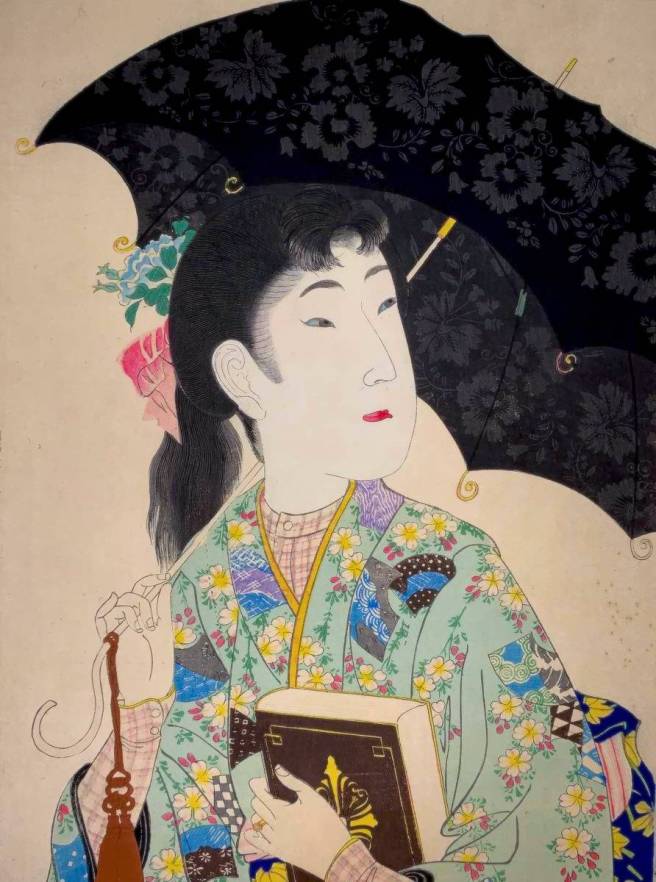
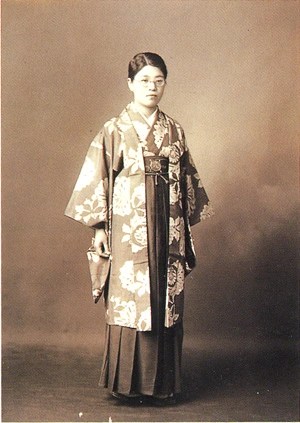
Besides blouses, women started to adopt hakama which were previously exclusively reserved for men. With more women entering education, female students were in need of a uniform which allowed them to participate in all school activities on the same level as the boys. Debates on movement and the body resulted in the decision to modify men‘s hakama trousers by turning them into hakama skirts for young women.

Toyohara Chikanobu (楊洲周延),「真美人 十四 洋傘をさす女学生」(Meiji 30, 1897).
© Ōta Memorial Museum of Art (太田記念美術館), Tokyo.
Young women wearing a short skirt, umbrella and lace shoes. Source unknown.

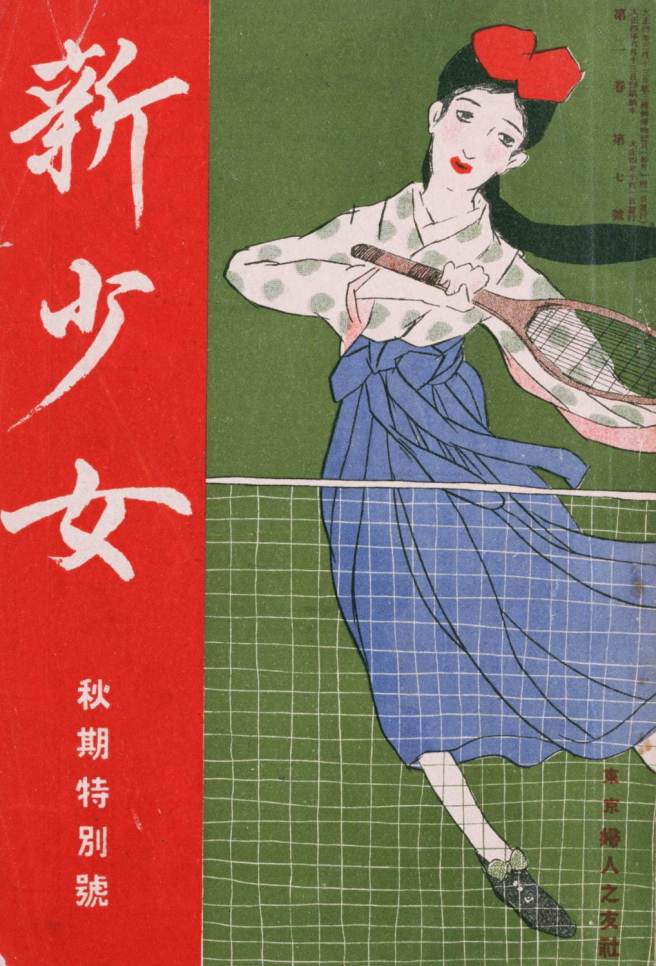
This hakama style was considered to allow for unrestricted movements of the hip and legs. This was particular important in a time when physical education became part of the school curriculum, and sports of all kinds became popular leisure activities. Shoes also played a part in this, with the traditional sandal footwear of geta being replaced by lace shoes and boots. The new mode of transportation, the bicycle, became favoured and later representative of the forward-thinking young men and women who were considered to built a bright future for the Japanese nation.

Yumeji Takehisa (竹久夢二), ‘Tennis’ (post-1900s).
Female student wearing a meisen kimono and haori combined with a women‘s hakama. Source unknown.

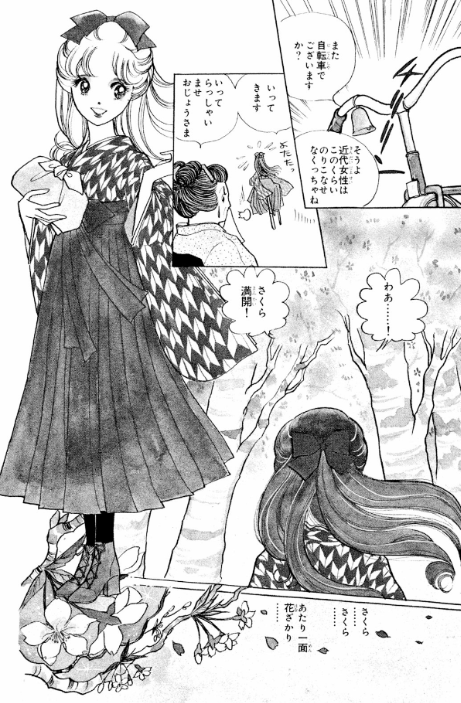
Another popular reference of the style is the manga Haikara-San: Here Comes Miss Modern (はいからさんが通る haikara-san ga tōru, 1975-77) by Waki Yamato. The manga that tells the story of Benio Hanamura, a young woman living in Tokyo in the 20th century. Benio is laballed as a ‘tomboy‘ with a big interest in Western culture and fashion. This sets her apart from and often creates a conflict with the more conservative Japanese women of her time. As a female student, she often wears a yabane-patterned furisode kimono and hakama combination as depicted below.

Cover picture of はいからさんが通る (1975-77) by Waki Yamato.
Panel on page 6 of はいからさんが通る (1975-77) by Waki Yamato.

Overall, the Taisho Roman kimono style was a reflection of the era’s fascination with modernity, individualism, and self-expression, and represented a departure from the more rigid and feminine conservative styles that had come before it.

Cardiff-Japanese Lecture Series: ‘Kimono (and) Fashion in Japan’

This online public lecture titled ‘Kimono (and) Fashion in Japan’ is part of the Cardiff-Japanese Lecture Series which aims to explore and understand aspects of language learning for those studying Japanese language and culture at Cardiff University, as well as various learners, teachers and researchers with an interest in Japan. The event is funded by the Japan Foundation, London.

Abstract
Both inside and outside of Japan, kimono is commonly framed as the national costume of Japan, bestowing the garment with notions of tradition and stability. However, ever since the establishment of a widespread fashion system in the Edo period (1603-1868), kimono was worn in different ways to communicate individual and social characteristics such as status, occupation, gender and taste.

This talk sheds some light on the fashionable influences on the garment by examining the following questions; how was kimono marketed by members of the merchant class, who became affluent during the Edo period? In which way did the moga (モガ, ‘modern girls’) of the Taisho period (1912-1926) wear the garment? How is the retro style, which gained prominence due to magazines such as Kimono Hime (Shōdensha, 2003-2018) and Kimono Anne (TAC Shuppan, 2019-), connected to the popularity of kimono as an everyday garment in recent decades?

Watch the recording of the lecture to find out more!

PhD Dissertation: ‘Negotiating Gendered Identities Through Dress: Kimono at the Coming-of-age Day in Contemporary Japan’

My PhD dissertation is now available online! Please refer to the details below for more information:

Becke, Carolin (2022) Negotiating Gendered Identities Through Dress: Kimono at the Coming-of-age Day in Contemporary Japan. PhD thesis, University of Sheffield.

This thesis is a study of kimono in contemporary Japan. It builds on and extends the literature on kimono by evaluating the garment’s role at the coming-of-age day. The coming-of-age day is a significant celebration aiming to inspire young women and men to become ‘good and upright adult citizen[s]‘ (Hendry 1981: 206). Being of immense importance to the construction of Japanese identity and culture, this thesis aims to explore how normative ideas, values and meanings surrounding coming-of-age dress are (re)framed in a contemporary setting.

Keywords: adulthood, class, coming-of-age, fashion, gender, identity, Japanese dress, kimono, subculture

Image Source: Tokyo Central Japanese Language School

Fashion Objects and the Changing Landscape of Fashion: ‘Sustaining Wellbeing through Kimono’

On May 6th, I spoke about my research on mental wellbeing and kimono at the Fashion Objects and the Changing Landscape of Fashion conference which was part of the Fashion Festival Debrecen. This research is inspired by a short, investigative article I wrote for the ‘Collecting Covid-19’ project initiated by the Centre for Digital Anthropology at University College London which encouraged scholars to collect responses to the unfolding covid-19 pandemic in early 2020.

During this time, I noticed a particular activeness of some of the kimono designers and enthusiasts I follow on Instagram; while life as we know it was drastically changing, members of the community reached towards kimono to provide them with a sense of stability and belonging in these challenging times. Imaginative challenges and exercises were set up to engage each other in creative endeavours, with individuals sharing images of affectionately coordinated kimono outfits which incorporated some of their newly learned kitsuke (kimono dressing) skills. I became fascinated by the ways in which the community took care of their mental health through an engagement with the garment, and decided to conduct some further research into the topic.

Besides the presentation at the conference, I am currently preparing a manuscript summarising my findings which I hope will become a published journal article titled ‘Sustaining Wellbeing through Kimono: Responses from the kimono fashion network to the covid-19 pandemic’.

Idol Identity Construction in Morning Musume モーニング娘。- ‘The Story of Noisy Girls’『女子かしまし物語』(2014)

The 2004 music video to Morning Musume‘s ‘The Story of Noisy Girls’ (女子かしまし物語, Joshi Kashimashi Mongatari) discloses a lot about the deliberate identity construction of idols. The video also demonstrates the way in which idol personas are constructed through dress. In this short article, I will start to unwrap some of the most significant aspects of idol identity construction and dress.

Morning Musume, an extremely popular Japanese female idol group which was formed in 1997 by singer-songwriter turned producer Tsunku, shaped the landscape of female idols particularly in the late 1990s and 2000s. New members would be casted on a regular basis, forming different ‘generations’. Members would eventually graduate from the group; the longer a girl stayed in the band, the more popular she is generally considered to be.

To gain popularity with fans, and therefore be allowed to stay in the band for a long time, members would create distinct personalities to make themselves differentiable from their peers. ‘The Story of Noisy Girls’ focuses on this practice, with the girls presenting their individuality through the lyrics, dress and presentation.

Below are the lyrics of member Nozomi Tsuji which showcase precisely how identity constructions within this song works:

「OK!辻希美さん」 オイ!
合コン日時が 決まった日
人数溢れて 呼べない
送っちゃいけないその子に
送信したらしい…
「ヘコむ~」
「あるある」
Group: "OK! Nozomi Tsuji"
Group: "Upon deciding the date/time for her gōkon (singles' party)
(she realised that) there's one girl too many.
Seems like she's contacting
The girl who she can't invite..."
Nozomi: "I'm so sad (because you can't come)"
Group: "I can see it (happening like this)"

Nozomi’s personality is presented as being interested in dating. She is framed as organising gōkon / single parties which hint at the fact that she is looking for a boyfriend herself. Because she got too excited about the prospects, she ended up inviting one girl too many. While this is marked as an imaginary scenario (idol groups are known to follow a strict ‘no dating’ policy), the band members confirm that this is a scenario which could happen in real life.

Screenshot from Morning Musume‘s ‘The Story of Noisy Girls’ (2004)

This presentation aligns with the persona Nozomi has since maintained in the Japanese media. In 2007, she got married to actor Taiyo Suguira in a shot-gun style wedding. Nozomi was already pregnant at that point, and the couple had three more children over the course of the next years. Her personal blog which she started in 2009 got extremely popular, and she was voted as an inspirational role model for young mothers. This demonstrates while idol identity is constructed, it often is based on the personality of the idol. This is arguably done to create a sense of ‘authenticity’ around the performers.

Authenticity is also important when it comes to the general lyrics of the song. These focus on the daily life of teenage girls and describe the fun and excitement of hanging out with friends, going shopping, and gossiping about boys. The lyrics also touch on the pressures that young girls face, such as the expectations to look pretty and act ladylike. This is the image which Morning Musume as a band wants to project; the members are oridnary teenage girls who ‘just wanna have fun’. They are the girls next door rather than the glamorous but unreachable celebrities seen in magazines.

Dress also plays an important role in constructing idol identity. In the video, Tsuji is wearing a seifuku-type school uniform, probably one of the most recognisable items of clothing not just of general Japanese society but also more specifically of idol dress.

While this on one hand marks her youth, another very important aspect of idol culture, it also pairs her with group member Kago Ai who is wearing the same outfit in the video. Their pairing is quite deliberate; having been nicknamed ‘the twins’ by fans, Tsuji and Kago formed the sub-group W later in 2004. While wearing a similar style of make-up, the two girls remain distinctable through their hairstyles.

Screenshot from the Making off: Morning Musume‘s ‘The Story of Noisy Girls (2004)

Idol dress also often makes a distinction between shifuku 私服 / ‘personal clothes’ and costumes worn on stage and in music videos. Idol music videos often show the boys and girls in their idol costumes as well as personal clothes. This is deliberately done to add another layer of authenticity – the persona of the idol aligns with their off-screen self, as is communicated through dress.

Screenshot from Morning Musume‘s ‘The Story of Noisy Girls’ (2004)

Tsuji and Kago are wearing the music video’s costumes in several shots throughout the video. Their clothes are identical, which is actually unusual for these costumes; while certainly aimed to visually unify, these costumes often get customised to perfectly fit the idols body and with it, perceived personality. Of course, in the case of Tsuji and Kago, it makes sense for them to wear the same costumes, as this once again strengthens the perception of their solidarity and sisterhood.

Colours plays an important part in idol dress as well; while this is not manageable for such a big group as Morning Musume, many idol bands use colours to differentiate the band members. The specific ‘member colour’ is also often perceived to be symbolic of the member’s persona. In ‘The Story of Noisy Girls’, colour is only used in a limited way, however; both Tsuji and Kago are wearing blue to once again signal unity.

In summary, we can say that dress plays a very important part in idol identity construction. With the need to carve out a distinctable persona, idols rely on dress and presentation to communicate their individuality to their fans. The most popular Japanese idols are arguably the ones whose personality aligns both on and off-screen – as demonstrated by ex-Morning Musume member Nozomi Tsuji.

Women’s Hakama: Female student’s school uniforms

Artist unknown.

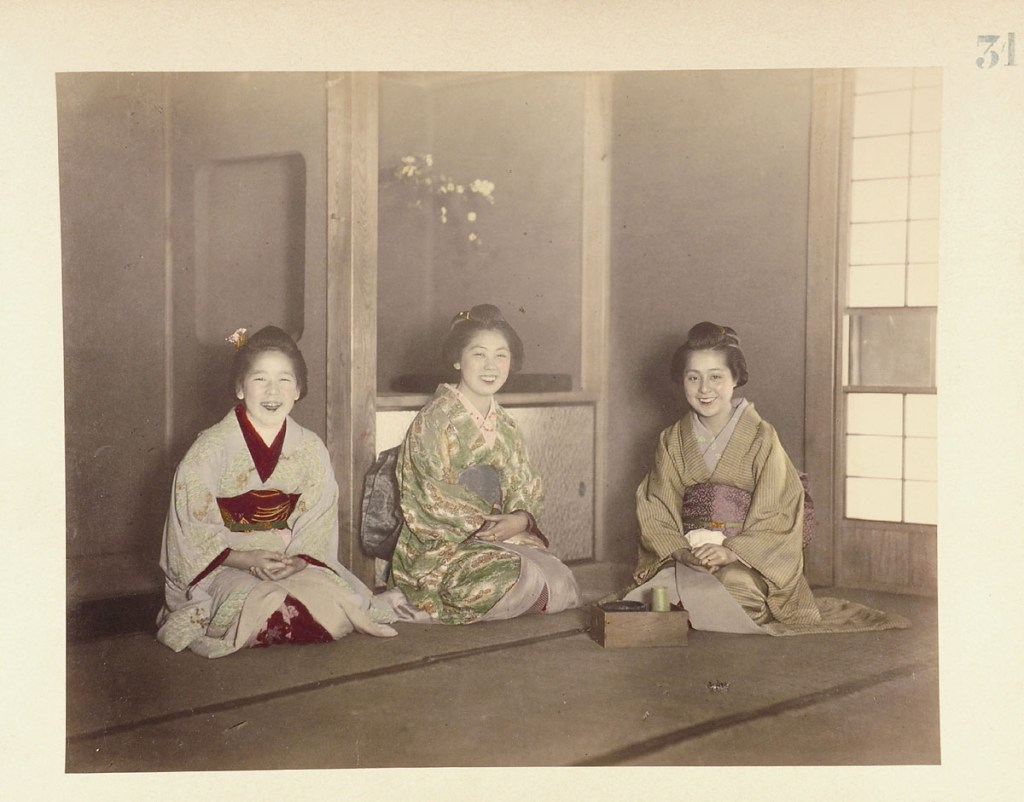
The three young women depicted here are all wearing the first version of Japanese school uniforms, consisting of a hakama (袴) skirt worn over a short-sleeved furisode kimono. Hakama are wide trousers which were one of the main garments for men during the Edo period. These trousers were slightly modified and turned into skirts, being tied at one’s waist rather than one’s hip for the sake of becoming uniforms for young females.

Just like their male counterparts who adopted uniforms in 1879, the rising number of female students during the late 19th century likewise called for unified clothing on their part. Being adopted on a nationwide level in 1898 (and held in place until 1918), an emphasis was put on the functionality of the hakama / kimono ensemble within an environment in which students were expected to participate in regular practices of sports and physical exercise. The addition of boots or leather shoes, as well as a big ribbon in one’s hair would later come to quintessentially represent early female students of the Meiji and Taishō period.

Photograph by Elstner Hilton (1914-8).
「自転車に乗る女学生」from 新版引札見本帖、第1 (Meiji 36, 1903).
© National Diet Library (国立国会図書館), Tokyo.

AKB48: ジワるDAYS

Having followed Japanese popular culture for quite some time now, I have found myself to be particularly curious about idol アイドル culture and aesthetics. Costumes play a very important role within the overall visual aspect of idols; they are utilised to signalise allegiance to one’s group through a general costume design on one hand, but also highlight individuality through the creation of a certain silhouette or allocation of a specific colour for the individual member on the other.

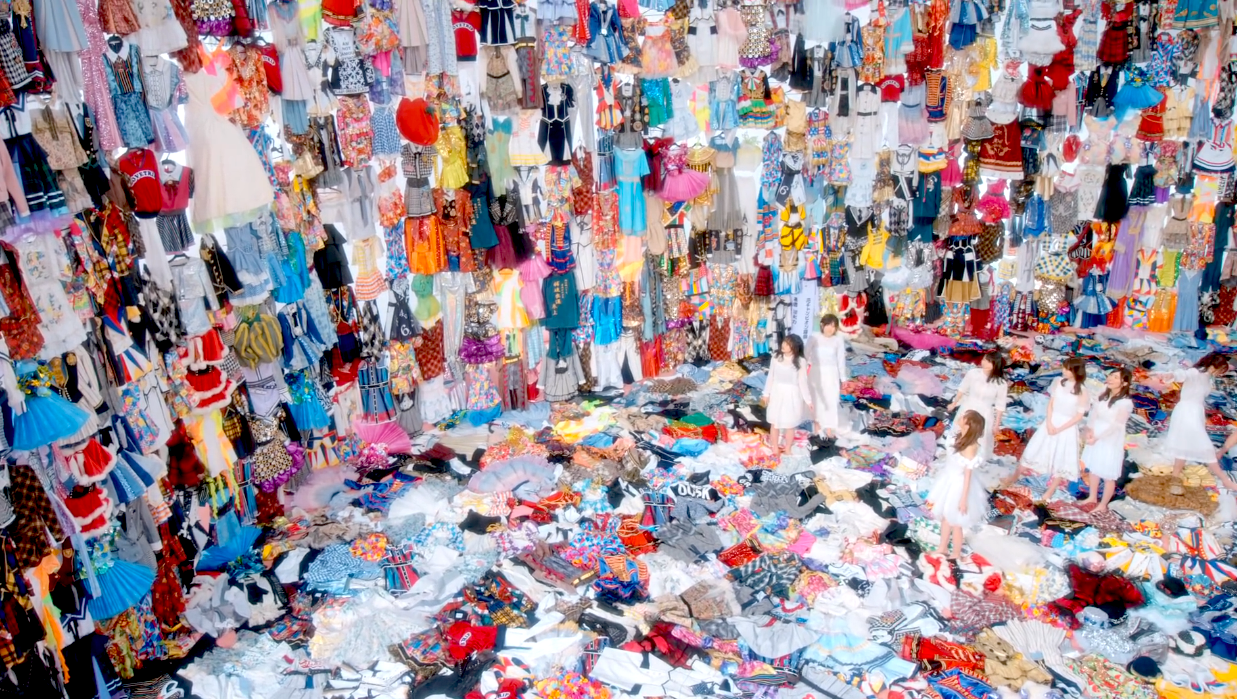
It was hence quite interesting to notice that popular idol group AKB48‘s video to their latest single ジワるDAYS (2019) featured all 345 costumes which member Sashihara Rino, who announced her graduation from the group in December, had worn over her 12 years of being an idol. The costumes are used for much of the videos background decoration, illustrating the sheer amount of clothing that is produced to maintain the idol image and character. Have a look for yourself below:

AKB48 – ジワるDAYS (2019)