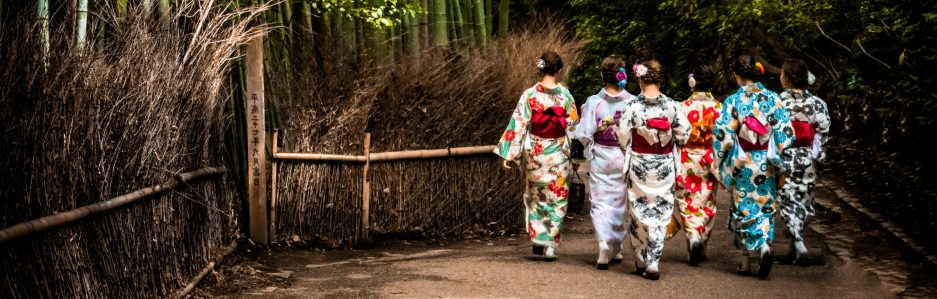
The 2004 music video to Morning Musume‘s ‘The Story of Noisy Girls’ (女子かしまし物語, Joshi Kashimashi Mongatari) discloses a lot about the deliberate identity construction of idols. The video also demonstrates the way in which idol personas are constructed through dress. In this short article, I will start to unwrap some of the most significant aspects of idol identity construction and dress.
Morning Musume, an extremely popular Japanese female idol group which was formed in 1997 by singer-songwriter turned producer Tsunku, shaped the landscape of female idols particularly in the late 1990s and 2000s. New members would be casted on a regular basis, forming different ‘generations’. Members would eventually graduate from the group; the longer a girl stayed in the band, the more popular she is generally considered to be.
To gain popularity with fans, and therefore be allowed to stay in the band for a long time, members would create distinct personalities to make themselves differentiable from their peers. ‘The Story of Noisy Girls’ focuses on this practice, with the girls presenting their individuality through the lyrics, dress and presentation.
Below are the lyrics of member Nozomi Tsuji which showcase precisely how identity constructions within this song works:
「OK!辻希美さん」 オイ!
合コン日時が 決まった日
人数溢れて 呼べない
送っちゃいけないその子に
送信したらしい…
「ヘコむ~」
「あるある」
Group: "OK! Nozomi Tsuji"
Group: "Upon deciding the date/time for her gōkon (singles' party)
(she realised that) there's one girl too many.
Seems like she's contacting
The girl who she can't invite..."
Nozomi: "I'm so sad (because you can't come)"
Group: "I can see it (happening like this)"
Nozomi’s personality is presented as being interested in dating. She is framed as organising gōkon / single parties which hint at the fact that she is looking for a boyfriend herself. Because she got too excited about the prospects, she ended up inviting one girl too many. While this is marked as an imaginary scenario (idol groups are known to follow a strict ‘no dating’ policy), the band members confirm that this is a scenario which could happen in real life.

This presentation aligns with the persona Nozomi has since maintained in the Japanese media. In 2007, she got married to actor Taiyo Suguira in a shot-gun style wedding. Nozomi was already pregnant at that point, and the couple had three more children over the course of the next years. Her personal blog which she started in 2009 got extremely popular, and she was voted as an inspirational role model for young mothers. This demonstrates while idol identity is constructed, it often is based on the personality of the idol. This is arguably done to create a sense of ‘authenticity’ around the performers.

Authenticity is also important when it comes to the general lyrics of the song. These focus on the daily life of teenage girls and describe the fun and excitement of hanging out with friends, going shopping, and gossiping about boys. The lyrics also touch on the pressures that young girls face, such as the expectations to look pretty and act ladylike. This is the image which Morning Musume as a band wants to project; the members are oridnary teenage girls who ‘just wanna have fun’. They are the girls next door rather than the glamorous but unreachable celebrities seen in magazines.
Dress also plays an important role in constructing idol identity. In the video, Tsuji is wearing a seifuku-type school uniform, probably one of the most recognisable items of clothing not just of general Japanese society but also more specifically of idol dress.
While this on one hand marks her youth, another very important aspect of idol culture, it also pairs her with group member Kago Ai who is wearing the same outfit in the video. Their pairing is quite deliberate; having been nicknamed ‘the twins’ by fans, Tsuji and Kago formed the sub-group W later in 2004. While wearing a similar style of make-up, the two girls remain distinctable through their hairstyles.

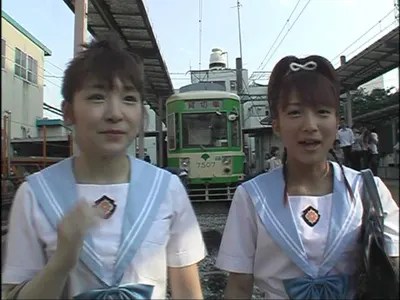
Screenshot from the Making off: Morning Musume‘s ‘The Story of Noisy Girls‘ (2004)
Idol dress also often makes a distinction between shifuku 私服 / ‘personal clothes’ and costumes worn on stage and in music videos. Idol music videos often show the boys and girls in their idol costumes as well as personal clothes. This is deliberately done to add another layer of authenticity – the persona of the idol aligns with their off-screen self, as is communicated through dress.

Tsuji and Kago are wearing the music video’s costumes in several shots throughout the video. Their clothes are identical, which is actually unusual for these costumes; while certainly aimed to visually unify, these costumes often get customised to perfectly fit the idols body and with it, perceived personality. Of course, in the case of Tsuji and Kago, it makes sense for them to wear the same costumes, as this once again strengthens the perception of their solidarity and sisterhood.
Colours plays an important part in idol dress as well; while this is not manageable for such a big group as Morning Musume, many idol bands use colours to differentiate the band members. The specific ‘member colour’ is also often perceived to be symbolic of the member’s persona. In ‘The Story of Noisy Girls’, colour is only used in a limited way, however; both Tsuji and Kago are wearing blue to once again signal unity.
In summary, we can say that dress plays a very important part in idol identity construction. With the need to carve out a distinctable persona, idols rely on dress and presentation to communicate their individuality to their fans. The most popular Japanese idols are arguably the ones whose personality aligns both on and off-screen – as demonstrated by ex-Morning Musume member Nozomi Tsuji.
 DR CAROLIN BECKE